
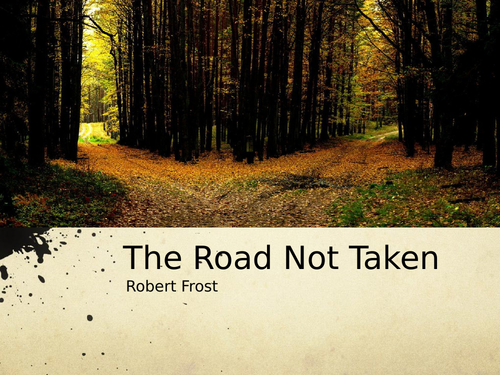
Introductions: “The Road Not Taken” by Robert Frost is a deceptively simple poem that delves into complex themes of choice, individuality, regret, and the way we construct our personal narratives. It represents the human characteristic of taking shortcut methods instead of the toiling. As the title suggests, we are preoccupied with the concerns of what we have not done, rather than what we can. If we are unable to live our present with satisfaction, human life will be full of “What could and should have been.” The “road” in the title does not only mean “path,” but also “decision.” So, the poem presents the regrets that human beings face due to the decisions they take and the decisions that they do not take. It also represents American Romanticism. Here’s an in-depth, stanza-by-stanza analysis:
Stanza 1:
“Two roads diverged in a yellow wood, And sorry I could not travel both And be one traveler, long I stood And looked down one as far as I could To where it bent in the undergrowth;”
- “Two roads diverged in a yellow wood”: This opening line immediately sets the scene. The “yellow wood” suggests autumn, a time of transition and change, perhaps symbolizing a point of transition in the speaker’s life. The “diverged” emphasizes the fork in the path, a moment of decision where two options present themselves.
- “And sorry I could not travel both / And be one traveler”: This expresses a fundamental human limitation. The speaker acknowledges the impossibility of experiencing both choices simultaneously. This inherent constraint is the catalyst for the entire poem.
- “long I stood / And looked down one as far as I could / To where it bent in the undergrowth;”: This highlights the speaker’s careful consideration. The act of “long I stood” suggests deliberation and the weight of the decision. Looking down one path “as far as I could” implies an attempt to foresee the consequences and the nature of that particular journey. The path disappearing into the “undergrowth” suggests the inherent uncertainty of the future; the full trajectory of any choice is unknowable.
Stanza 2:
“Then took the other, as just as fair, And having perhaps the better claim, Because it was grassy and wanted wear; Though as for that the passing there Had worn them really about the same,”
- “Then took the other, as just as fair,”: After deliberation, the speaker makes a choice. The phrase “just as fair” initially suggests that the two options were equally appealing. This introduces a layer of ambiguity, as the subsequent lines complicate this initial impression.
- “And having perhaps the better claim, / Because it was grassy and wanted wear;”: This is the justification for the choice. The speaker believes the second path is “better” because it appeared “grassy and wanted wear,” suggesting it was less traveled and offered a more unique or less conventional experience. This aligns with a desire for individuality.
- “Though as for that the passing there / Had worn them really about the same,”: This crucial line undermines the initial justification. The speaker, upon closer inspection (implied by the shift in perspective), realizes that both paths were actually quite similar in terms of wear. This introduces the theme of self-deception or the way we retrospectively rationalize our choices. The “passing there” refers to the travelers who had already taken those paths.
Stanza 3:
“And both that morning equally lay In leaves no step had trodden black. Oh, I kept the first for another day! Yet knowing how way leads on to way, I doubted if I should ever come back.”
- “And both that morning equally lay / In leaves no step had trodden black.”: This reinforces the idea that at the moment of decision, neither path was significantly different. The “leaves no step had trodden black” vividly portrays a fresh, untouched start for both options. This contradicts the earlier notion that one path was “grassy and wanted wear.”
- “Oh, I kept the first for another day!”: This expresses a common human tendency to postpone choices, believing there will be future opportunities. However, the tone of “Oh” might carry a hint of wistfulness or even a subtle awareness of the unlikelihood of this happening.
- “Yet knowing how way leads on to way, / I doubted if I should ever come back.”: This reveals a deeper understanding of the nature of life’s journeys. The speaker recognizes that one decision often leads to a series of others, making it improbable to retrace one’s steps and experience the alternative path. This adds a sense of finality to the choice.
Stanza 4:
“I shall be telling this with a sigh Somewhere ages and ages hence: Two roads diverged in a wood, and I— I took the one less traveled by, And that has made all the difference.”
- “I shall be telling this with a sigh / Somewhere ages and ages hence:”: This shifts the poem to a future perspective. The “sigh” is ambiguous. It could be a sigh of contentment and satisfaction at having chosen the less conventional path. However, it could also be a sigh of regret, a wistful acknowledgment of the path not taken and the unknowable possibilities it held. The phrase “ages and ages hence” emphasizes the enduring impact of this decision on the speaker’s life narrative.
- “Two roads diverged in a wood, and I— / I took the one less traveled by,”: This is the line that has become iconic and is often misinterpreted. Given the earlier stanzas, it’s crucial to remember the speaker’s initial (and perhaps inaccurate) perception that the chosen path was less traveled. This line might reflect the story the speaker tells themselves and others about their life.
- “And that has made all the difference.”: This is the final statement, and its meaning is heavily debated. If the speaker genuinely believed the paths were different, this line expresses the profound impact of that seemingly small choice. However, considering the earlier realization that the paths were “really about the same,” this line could also be interpreted ironically. The speaker might be constructing a narrative of individuality and consequence, even if the initial difference was negligible. The “difference” might lie more in the story the speaker tells than in the actual experience of the paths.
Overall Themes and Interpretation:
- The Illusion of Choice and Individuality: The poem questions whether our choices are as significant or as unique as we believe them to be. The initial perception of a less-traveled path is later contradicted, suggesting that we often create narratives about our individuality even when the reality is more nuanced.
- The Power of Retrospection and Narrative: The poem highlights how we frame our past decisions and construct our life stories. The speaker’s future retelling, potentially with a “sigh,” suggests the subjective nature of memory and the tendency to emphasize certain aspects of our choices.
- Regret and the Unknowable: The poem subtly touches upon the theme of regret, or at least the awareness of what might have been. The inability to travel both paths leaves a lingering sense of the unknown and the potential alternative life.
- Ambiguity and Irony: The poem’s power lies in its ambiguity. The “sigh” and the final line can be interpreted in multiple ways, leading to ongoing discussion about Frost’s true intent. There’s a strong argument for an ironic reading, where the speaker romanticizes a choice that was perhaps less significant than they later claim.
Significance of the Title:
The title “The Road Not Taken” is profoundly significant and operates on multiple levels, contributing significantly to the poem’s central themes and its enduring impact. Here’s a breakdown of its significance:
Directly References the Central Conflict: The title immediately points to the core decision presented in the poem: the speaker standing at a fork in the road and having to choose one path while leaving the other untraveled. It highlights the moment of divergence and the inherent limitation of not being able to experience both options.
Emphasizes the Unchosen Path: By focusing on “The Road Not Taken,” the title subtly shifts the emphasis from the path chosen to the path left behind. This draws our attention to the realm of “what if?” and the inevitable speculation about the alternative experience. It hints at the human tendency to ponder missed opportunities and imagine different outcomes.
Symbolic of Life Choices: The “road” serves as a powerful metaphor for the choices we make in life. These choices, whether seemingly small or significantly impactful, shape our individual journeys and lead us down particular trajectories. The title suggests that the paths we don’t take are just as significant, if not more so, in shaping our internal narratives and sense of self.
Highlights the Speaker’s Future Reflection: The title primes the reader for the final stanza, where the speaker reflects on the decision “ages and ages hence.” The title suggests that the significance of the choice, and perhaps more importantly, the memory of the unchosen path, will persist throughout the speaker’s life.
Contributes to the Poem’s Irony and Ambiguity: Given the poem’s nuanced portrayal of the two paths as being “really about the same,” the title “The Road Not Taken” can be seen as slightly ironic. The speaker later claims to have taken the “one less traveled by,” a statement that might be a self-constructed narrative. The title then becomes a marker of this constructed narrative, emphasizing the power of the story we tell ourselves about our lives and the choices we make.
Evokes a Sense of Loss or Regret (Potentially): The phrase “not taken” carries a subtle undertone of something missed or foregone. While the poem doesn’t explicitly state regret, the title invites the reader to consider this possibility. The “sigh” mentioned in the final stanza further reinforces this potential sense of wistfulness or contemplation about the alternative.
Universality and Relatability: The title’s simplicity and metaphorical resonance make it universally relatable. Everyone has faced choices and pondered the paths not taken in their own lives, making the poem’s central theme and its title deeply accessible.
Conclusion: In essence, the title “The Road Not Taken” is not just a label for the poem; it is a key element that encapsulates the poem’s central themes of choice, the significance of the unexperienced, the power of narrative, and the potential for both genuine impact and self-constructed meaning in the decisions we make. It invites reflection on the roads we have traveled and the enduring presence of those we have left behind. In conclusion, “The Road Not Taken” is not simply a celebration of choosing the unconventional path. It’s a more complex and introspective poem that explores the nature of decision-making, the human tendency to create meaningful narratives, and the potential for self-deception in how we remember and interpret our past. The poem’s enduring popularity lies in its ability to resonate with the universal experience of making choices and wondering about the roads not taken.
Very good https://lc.cx/xjXBQT
Good https://t.ly/tndaA
Good https://is.gd/N1ikS2