
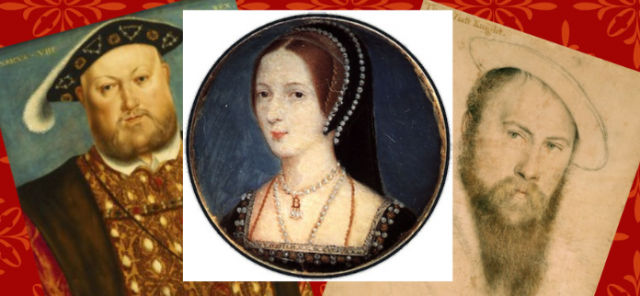
This poem, “Forget not Yet the Tried Intent” by Sir Thomas Wyatt (1503–1542), is a powerful example of Tudor-era lyric poetry. It is a direct and passionate plea from a devoted, but forsaken, lover to his beloved, urging her not to forget the sincerity and steadfastness of his long-suffering commitment.
Contents
Background to the Poem
The poem is a prime example of the courtly love tradition that Wyatt, who is credited with introducing the sonnet to English literature, adapted with a unique blend of personal passion and melancholy.
- Author and Context: Sir Thomas Wyatt was a diplomat and courtier in the court of King Henry VIII. His poetry often reflects the political intrigue and emotional trials of courtly life, frequently dealing with themes of fickle love, betrayal, and constancy in the face of indifference.
- Allegorical Subject: It is widely believed that this poem, along with many of Wyatt’s love lyrics, is addressed to Anne Boleyn, whom Wyatt knew and may have loved before she became the focus of King Henry VIII’s desire. The poem can be read as a farewell message, a final, earnest request to the woman he can no longer have to at least remember the genuineness of his “tried intent.”
- Theme: The core theme is the speaker’s unwavering devotion versus his lover’s perceived forsaking. The speaker emphasizes the longevity, purity, and sheer travail (effort/suffering) he endured, all spent for a love that was ultimately not fully reciprocated or honored.
Line-by-Line Analysis
The poem is structured into four-line stanzas (quatrains) with the repeated plea acting as a refrain. The rhyme scheme in the provided stanzas is AAAB.
Stanza 1
| Line | Text | Analysis/Meaning |
|---|---|---|
| 1 | Forget not yet the tried intent | Do not yet forget my sincere and proven purpose, or the intent of my heart that has been tested by time and adversity. |
| 2 | Of such a truth as I have meant; | A truth (or faithfulness) that was always genuine and intended. |
| 3 | My great travail so gladly spent, | The great effort, trouble, and suffering I endured, which I was happy to spend (give up) for your sake. |
| 4 | Forget not yet. | Do not forget this. (The core plea). |
Stanza 2
| Line | Text | Analysis/Meaning |
|---|---|---|
| 5 | Forget not yet when first began | Do not yet forget the time my weary life as your suitor began. |
| 6 | The weary life ye know, since whan. | The exhausting, troublesome life that you, the beloved, have been aware of ever since that time (“whan” = when). |
| 7 | The suit, the service, none tell can; | The long process of my courtship (“suit”) and the loyal service I rendered, the full extent of which cannot be fully described by anyone. |
| 8 | Forget not yet. | Do not forget this long-suffering service. |
Stanza 3
| Line | Text | Analysis/Meaning |
|---|---|---|
| 9 | Forget not yet the great assays, | Do not yet forget the great trials, tests, or tribulations (of my love). |
| 10 | The cruel wrong, the scornful ways; | The cruel injustices and the contemptuous/scornful manner in which I was treated, presumably by the beloved or the court. |
| 11 | The painful patience in denays, | The painful, long-suffering patience I showed despite your repeated denials and rejections (“denays”). |
| 12 | Forget not yet. | Do not forget the suffering I endured. |
Stanza 4
| Line | Text | Analysis/Meaning |
|---|---|---|
| 13 | Forget not yet, forget not this, | A double, more insistent plea to remember. |
| 14 | How long ago hath been and is. | How long this love has been ongoing—it existed long ago and continues to exist in the present. |
| 15 | The mind that never meant amiss; | The mind (my intentions) that was always pure and never had ill-will or wrong intentions. |
| 16 | Forget not yet. | Do not forget the longevity and purity of my love. |
Stanza 5
| Line | Text | Analysis/Meaning |
|---|---|---|
| 17 | Forget not then thine own approved, | Do not forget then (in the final end) the person you once accepted or approved of (the speaker). |
| 18 | The which so long hath thee so loved, | The one who has given you such long and true love. |
| 19 | Whose steadfast faith yet never moved; | The one whose unwavering loyalty and constancy has never changed or shifted. |
| 20 | Forget not this. | A final, definitive, and slightly varied plea. |
Figures of Speech
The poem uses a number of rhetorical devices to emphasize the speaker’s urgent and emotional plea.
| Figure of Speech | Definition & Explanation | Example from the Poem |
|---|---|---|
| Anaphora / Epistrophe | Repetition of a word or phrase at the beginning (anaphora) and/or the end (epistrophe) of successive clauses or stanzas. Used to create emphasis, rhythm, and a strong rhetorical effect. | The repetition of the phrase “Forget not yet” at the start of multiple stanzas (Anaphora) and at the end of stanzas 1-4 (Epistrophe/Refrain). |
| Refrain | A line or set of lines that is repeated regularly in a poem. It reinforces the central theme or idea. | The core line “Forget not yet” is the central refrain, acting as the foundation of the speaker’s emotional plea. |
| Alliteration | The repetition of consonant sounds at the beginning of words that are close together. | painful patience (Stanza 3); suit, the service (Stanza 2); mind that never meant amiss (Stanza 4). |
| Rhetorical Question/Plea | The entire poem is structured as a powerful, sustained plea, constantly urging the beloved to acknowledge and remember the speaker’s suffering and loyalty. | Every stanza opens with the negative imperative “Forget not yet,” which serves as a powerful rhetorical mechanism to compel the beloved to remember. |
Aman Pal
Literatureman