
Setting
Macbeth is set chiefly in Scotland during the 11th century.
- Atmosphere: Dark, ominous, and chaotic. The physical landscape mirrors the moral decay of the characters.
- Key Locations:
- Inverness: Macbeth’s castle, where the initial, horrific murder of King Duncan takes place.
- Forres: The royal palace where Duncan resides and where Macbeth later takes the throne.
- Dunsinane Hill: A strategic military fortification where Macbeth makes his final stand.
- Birnam Wood: The forest surrounding Dunsinane, which plays a pivotal role in the fulfillment of the Witches’ prophecies.
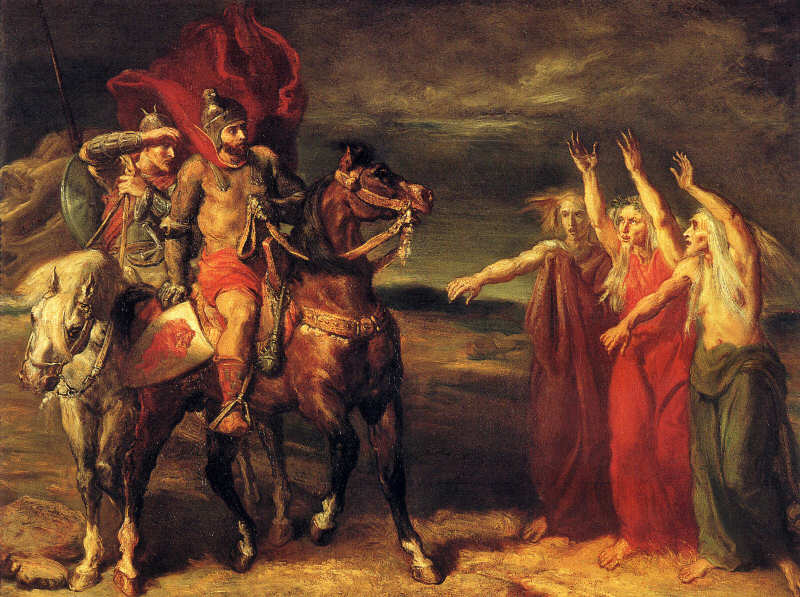
- The Heaths: Desolate, stormy moors where the Witches gather, symbolizing a thin veil between reality and the supernatural.
Background and History
Shakespeare wrote Macbeth around 1606, shortly after James VI of Scotland ascended to the English throne as King James I. The play was carefully tailored to appeal directly to the new monarch’s interests and anxieties:
- The Gunpowder Plot (1605): A failed assassination attempt against King James by Catholic dissidents. Macbeth’s themes of treason, regicide, and the ultimate doom of usurpers served as a cautionary tale and a warning to potential rebels.
- Daemonologie: King James was obsessed with witchcraft and wrote a book on the subject. Shakespeare included the Three Witches to tap into the King’s fear and fascination with the occult.
- The Banquo Connection: Stuart lineage traced its roots back to the historical Banquo. Shakespeare altered historical facts to present Banquo as a noble, blameless figure, thereby flattering King James, who was supposedly Banquo’s direct descendant.
Summary
The play opens with three witches prophesying that Macbeth, the Thane of Glamis, will become Thane of Cawdor and then King of Scotland. Shortly after, Macbeth is indeed named Thane of Cawdor for his bravery in battle. Consumed by ambition and spurred on by his calculating wife, Lady Macbeth, he assassinates King Duncan while the King is a guest at his castle.
Macbeth seizes the crown but is instantly consumed by guilt and paranoia. To secure his position, he orders the murder of his friend Banquo (whose descendants were prophesied to rule) and the family of the noble Macduff. As Macbeth devolves into a tyrannical monster, Lady Macbeth is driven mad by guilt and commits suicide.
Civil war erupts. Backed by the English army, Malcolm (Duncan’s rightful heir) and Macduff march on Scotland. Macduff ultimately kills Macbeth in battle, fulfilling the nuances of the Witches’ cryptic prophecies, and Malcolm is crowned the rightful King.
Major Themes
| Theme | Description |
| Ambition | The destructive nature of unchecked ambition. It acts as Macbeth’s “vaulting ambition” and primary flaw, blinding him to moral consequences. |
| Fate vs. Free Will | The tension between whether the Witches’ prophecies are inevitable destiny, or if Macbeth’s own choices and actions bring them to fruition. |
| Appearance vs. Reality | Encapsulated by the phrase “Fair is foul, and foul is fair.” Nothing is as it seems—loyal subjects are traitors, and prophecies are deceptive half-truths. |
| Guilt and Madness | The psychological toll of sin. Both Macbeth and Lady Macbeth suffer horrific hallucinations, sleeplessness, and eventual psychological ruin. |
| Kingship vs. Tyranny | A comparison of a good ruler (Duncan/Malcolm), who rules with divine right and care, versus a tyrant (Macbeth), who rules through fear, murder, and chaos. |
Acts and Scenes Explanation
Act I: The Temptation
- Scenes 1–4: The Witches establish the eerie tone. Macbeth and Banquo win a great battle. The Witches prophesy Macbeth’s kingship and that Banquo’s sons will be kings. Macbeth is named Thane of Cawdor, igniting his dark desires.
- Scenes 5–7: Lady Macbeth receives Macbeth’s letter. Fearing he is “too full o’ the milk of human kindness,” she famously prays to spirits to “unsex” her. When Duncan arrives at Inverness, she successfully goads a hesitating Macbeth into committing regicide.
Act II: The Deed
- Scenes 1–2: Macbeth sees a vision of a bloody dagger leading him to Duncan’s room. He commits the murder but is too shaken to frame the guards. Lady Macbeth coldly finishes the job, smearing the guards with blood.
- Scenes 3–4: Duncan’s body is discovered by Macduff. Macbeth kills the guards out of “fury.” Duncan’s sons, Malcolm and Donalbain, flee for their lives, making them look suspicious and clearing Macbeth’s path to the throne.
Act III: Paranoia and Turning Point
- Scenes 1–3: Macbeth, now king, fears Banquo and hiring assassins to kill him and his son, Fleance. Banquo is murdered, but Fleance escapes—marking the turning point where Macbeth’s control begins to slip.
- Scenes 4–6: At a state banquet, Macbeth is terrified by the Ghost of Banquo, visible only to him. His erratic behavior panics the lords. Macduff flees to England to join Malcolm.
Act IV: The Descent into Tyranny
- Scene 1: Macbeth revisits the Witches. They give him three new deceptive prophecies: beware Macduff, no man born of a woman can harm him, and he will not be defeated until Birnam Wood moves to Dunsinane.
- Scenes 2–3: Feeling invincible, Macbeth brutally slaughters Macduff’s innocent wife and children. In England, Macduff learns of this horror and vows personal revenge, joining forces with Malcolm’s army.
Act V: Retribution
- Scenes 1–5: Lady Macbeth, completely broken by guilt, sleepwalks while trying to wash imaginary blood from her hands (“Out, damned spot!”). She dies offstage. Macbeth receives news that Birnam Wood appears to be moving (the English army is camouflaging themselves with branches).
- Scenes 6–9: The English forces breach the castle. Macduff confronts Macbeth and reveals he was delivered via Caesarean section (“untimely ripped”), thus not technically “born of woman.” Macduff beheads Macbeth, and Malcolm is restored to the throne.
Major Character Sketch
An analysis of Macbeth and Lady Macbeth reveals one of the most compelling, psychologically complex dynamics in literary history. While they begin the play bound by a shared, fierce ambition, their trajectories move in completely opposite directions: Macbeth starts with a troubled conscience and ends as a desensitized tyrant, while Lady Macbeth begins with ruthless certainty and ends utterly broken by guilt.
Macbeth: The Devolution of a Tragic Hero
Macbeth’s character arc is a profound study in how unchecked ambition, coupled with guilt, can completely erode a man’s moral fiber.
The Noble Warrior (The Starting Point)
At the play’s opening, Macbeth is introduced through the praise of others as “brave Macbeth” and “Valour’s minion.” He is a loyal, courageous general who fiercely defends his king and country. He is not naturally a cold-blooded murderer; when the Witches first deliver their prophecy, his immediate reaction is fear because the thought of murdering Duncan makes his “seated heart knock at [his] ribs.”
The “Vaulting Ambition” and Fatal Flaw
Macbeth’s tragic flaw (hamartia) is his ambition, which he famously describes as a horse that overleaps itself:
“I have no spur / To prick the sides of my intent, but only / Vaulting ambition…” (Act 1, Scene 7)
He knows right from wrong and lists excellent reasons not to kill Duncan (he is Duncan’s kinsman, subject, and host). Yet, his desire for power, triggered by the Witches and weaponized by his wife, overrides his moral judgment.
The Trauma of Guilt and Paranoia
The moment Macbeth commits regicide, his psychological ruin begins. He is instantly plagued by auditory and visual hallucinations. He hears a voice cry, “Macbeth shall sleep no more,” symbolizing that by murdering the king, he has murdered his own peace of mind.
Unlike a psychopath, Macbeth feels the full weight of his sin early on. He laments that all the water in “great Neptune’s ocean” cannot wash the blood from his hands; instead, his hands will stain the green seas red.
The Tyrant’s Numbness (The Ending Point)
To cope with his intense paranoia and secure his throne, Macbeth determines that the only way forward is more violence. He orders the slaughter of Banquo and Macduff’s innocent family. By Act 5, Macbeth has become entirely desensitized to horror. When he hears the cries of women mourning his wife’s suicide, he coldly remarks:
“I have almost forgot the taste of fears… I have supped full with horrors.” (Act 5, Scene 5)
He ends his life viewing existence as completely meaningless—“a tale / Told by an idiot, full of sound and fury, / Signifying nothing.” He dies with a desperate, cynical bravado, a shell of the noble man he once was.
Lady Macbeth: The Facade of Ruthlessness
Lady Macbeth is initially presented as the driving force behind the murder of Duncan, exhibiting a chilling lack of empathy that contrasts sharply with her husband’s hesitation.
Rejecting Femininity and Humanity
Upon reading Macbeth’s letter about the prophecies, Lady Macbeth immediately fears that her husband is “too full o’ the milk of human kindness” to take the crown by force. She consciously chooses to suppress her own conscience, delivering her famous “unsex me here” soliloquy:
“Come, you spirits / That tend on mortal thoughts, unsex me here, / And fill me from the crown to the toe top-full / Of direst cruelty!” (Act 1, Scene 5)
She demands that her blood be made thick and her breastmilk be turned to gall, associating femininity with weakness and cruelty with masculinity. She becomes the ultimate manipulator, attacking Macbeth’s manhood until he agrees to the deed.
The Mask of Total Control
Directly after the murder, while Macbeth is unraveling, Lady Macbeth is the pragmatic one. She takes the bloody daggers back to the chamber and dismisses his terror with the line, “A little water clears us of this deed.” She maintains a mask of absolute control and iron will, even successfully covering for Macbeth’s erratic behavior when he sees Banquo’s ghost at the banquet.
The Psychological Collapse
Lady Macbeth’s tragedy is that she fundamentally misunderstood her own nature. She assumed she could simply switch off her conscience, but her guilt, repressed during the day, consumes her subconscious mind at night.
In Act 5, Scene 1, we see her completely broken, sleepwalking and obsessively trying to rub away an imaginary spot of blood on her hands:
“Out, damned spot! out, I say!… All the perfumes of Arabia will not sweeten this little hand.” (Act 5, Scene 1)
This directly mirrors and subverts her earlier claim that “a little water” would wash the deed away. Unable to bear the crushing weight of her psychological torment and her total isolation from a now-unfeeling Macbeth, she ultimately commits suicide.
The Relationship Dynamics: A Cross-Over Inversion
The relationship between Macbeth and Lady Macbeth is defined by a striking role reversal as the play progresses.
[Macbeth: Hesitant/Guilt-ridden] —-> [Macbeth: Ruthless/Unfeeling Tyrant]
\ /
\ / (The Inversion of Roles)
\/
[Lady Macbeth: Cold/Manipulative] —-> [Lady Macbeth: Broken/Mad with Guilt]
- Act 1 & 2: Lady Macbeth is the dominant, driving force; Macbeth is passive, plagued by moral doubt, and reliant on her strength.
- Act 3: As Macbeth begins plotting the murder of Banquo without consulting her, he tells her to remain “innocent of the knowledge.” The power dynamic begins to shift.
- Act 4 & 5: Macbeth takes total, tyrannical control, acting ruthlessly without a second thought. Lady Macbeth is sidelined, retreating into the domestic sphere of the castle, completely overwhelmed by the very guilt Macbeth has managed to harden himself against.
Ultimately, they swap psychological spaces. Macbeth adopts the cold ruthlessness Lady Macbeth initially prayed for, while Lady Macbeth is destroyed by the very conscience Macbeth managed to silence.
Both characters are driven by the same ambition, but what makes their characterizations so brilliant is how Shakespeare demonstrates that a crime against nature and the moral order destroys the human psyche in two distinct ways: through the fiery, violent paranoia of Macbeth, and the icy, imploding despair of Lady Macbeth.
The Three Witches (The Weird Sisters)
- Profile: Supernatural entities representing fate (the Old English word wyrd means fate).
- Role: They do not force Macbeth to act; instead, they plant malicious seeds of thought through ambiguous prophecies (equivocation), exploiting his inherent flaws to orchestrate chaos.
Banquo
- Profile: Macbeth’s fellow general and closest friend.
- Role: He serves as a moral foil to Macbeth. Presented with the same Witches, Banquo chooses skepticism and moral integrity over ambition, refusing to act on his prophecies through dishonorable means.
Macduff
- Profile: The Thane of Fife; a fiercely loyal, honest Scottish nobleman.
- Role: He represents holy retribution. Unlike Macbeth, Macduff puts his country above his family and self-interest. He becomes Macbeth’s ultimate nemesis, combining personal grief with righteous political vengeance.
Literary Devices
Shakespeare utilizes an array of literary devices to heighten the play’s psychological depth and grim atmosphere:
- Equivocation (Half-truths): The language of the Witches. They use language that has double meanings to deceive Macbeth (e.g., “none of woman born shall harm Macbeth”).
- Motifs:
- Blood: Represents inescapable guilt. It transforms from physical evidence of a crime to a psychological stain that cannot be washed away.
- Sleeplessness: Symbolizes the loss of innocence and peace. By killing the King, Macbeth “does murder sleep.”
- Clothing: Metaphor for social titles. Macbeth’s new titles are often described as “borrowed robes” or clothes that do not fit him, emphasizing his status as an illegitimate usurper.
- Soliloquy: Used extensively to give the audience direct access to Macbeth’s deteriorating psychological state (e.g., the “Is this a dagger which I see before me?” or the existential “Tomorrow, and tomorrow, and tomorrow” speech).
- Dramatic Irony: Occurs frequently, such as when King Duncan praises the pleasant atmosphere of Macbeth’s castle, entirely unaware that the hosts are planning his brutal murder inside.
- Pathetic Fallacy: The natural world reflecting human actions. On the night of Duncan’s murder, wild storms rage, horses eat each other, and the earth shakes, symbolizing that the killing of a king breaks the natural, divine order of the universe.
Important Quotations:
1. The Theme of Appearance vs. Reality
> “Fair is foul, and foul is fair; / Hover through the fog and filthy air.”
(The Witches, Act 1, Scene 1)
- Explanation: Spoken by the Three Witches in the very first scene, this line establishes the overarching moral ambiguity of the play. It means that what appears good and beautiful (“fair”) is actually evil and corrupt (“foul”), and vice versa.
- Significance: It serves as a warning to the audience that nothing in the play is as it seems. It sets up a world of deception, inversion, and moral chaos, foreshadowing how Macbeth’s apparent glory will lead to his moral rot.
> “Look like the innocent flower, / But be the serpent under ‘t.”
(Lady Macbeth, Act 1, Scene 5)
- Explanation: Lady Macbeth is advising her husband on how to behave when King Duncan arrives at their castle. She tells him to maintain a welcoming, loyal, and innocent facial expression while hiding his murderous intentions beneath the surface.
- Significance: This is a direct invocation of the theme of duplicity. The imagery of the “serpent” has biblical undertones, reminiscent of the snake in the Garden of Eden, casting Lady Macbeth in the role of the tempter urging Macbeth to commit the ultimate sin.
2. Ambition and Hesitation
> “I have no spur / To prick the sides of my intent, but only / Vaulting ambition, which o’erleaps itself / And falls on the other.”
(Macbeth, Act 1, Scene 7)
- Explanation: In this soliloquy, Macbeth acknowledges that he has no valid, justifiable reason (no “spur”) to murder Duncan, who has been a good and fair king. The only thing driving him forward is his own immense, uncontrolled ambition. He uses the metaphor of a rider trying to leap onto a horse but jumping too hard and falling on the other side.
- Significance: This reveals Macbeth’s deep self-awareness before the murder. He foresees that his ambition is a tragic flaw (hamartia) that will ultimately lead to his own downfall, yet he chooses to proceed anyway.
3. The Psychological Weight of Guilt
> “Will all great Neptune’s ocean wash this blood / Clean from my hand? No, this my hand will rather / The multitudinous seas incarnadine, / Making the green one red.”
(Macbeth, Act 2, Scene 2)
- Explanation: Immediately after murdering Duncan, a panicked Macbeth looks at his bloody hands. He wonders if all the water in the ocean could wash away the physical and metaphorical stain of his crime. He concludes that instead of the ocean cleaning his hands, his guilt-stained hands will turn the entire green ocean red (“incarnadine”).
- Significance: This hyperbole illustrates the instant, overwhelming magnitude of Macbeth’s guilt. It stands in stark contrast to Lady Macbeth’s practical mindset in the same scene, highlighting his profound moral shock.
> “Out, damned spot! out, I say!—One, two: why, then, ’tis time to do ‘t.—Hell is murky!”
(Lady Macbeth, Act 5, Scene 1)
- Explanation: Spoken by Lady Macbeth while she is sleepwalking, witnessed by her doctor and gentlewoman. In her madness, she is rubbing her hands together, hallucinating that Duncan’s blood is still on them and refusing to wash off.
- Significance: This quote marks the complete psychological collapse of Lady Macbeth. It directly subverts her confident Act 2 assertion that “A little water clears us of this deed.” It proves that while she suppressed her conscience in the daytime, her guilt has entirely consumed her subconscious mind.
4. The Loss of Peace and Sleep
> “Methought I heard a voice cry ‘Sleep no more! / Macbeth does murder sleep’—the innocent sleep,”
(Macbeth, Act 2, Scene 2)
- Explanation: Right after committing the regicide, Macbeth tells his wife that he heard a ghostly voice crying out that he has murdered sleep itself. He describes sleep as “innocent,” the healer of life’s hurts and nourishment of the mind.
- Significance: Sleep in Shakespeare is a symbol of innocence, peace, and natural order. By killing the rightful king, Macbeth has fractured the natural order and destroyed his own peace of mind. For the rest of the play, both he and Lady Macbeth are tortured by nightmares and insomnia.
5. Existential Despair and Nihilism
> “Tomorrow, and tomorrow, and tomorrow, / Creeps in this petty pace from day to day / To the last syllable of recorded time,”
(Macbeth, Act 5, Scene 5)
- Explanation: Macbeth utters these words after being informed that Lady Macbeth has committed suicide. Instead of grieving openly, he reflects on the absolute pointlessness of life. He views time as a slow, agonizing crawl toward inevitable death.
- Significance: This is one of the most famous soliloquies in literature. It demonstrates Macbeth’s total emotional numbness and existential despair. Having lost his wife, his honor, and his humanity, he realizes that his pursuit of power was entirely hollow.
> “Life’s but a walking shadow, a poor player / That struts and frets his hour upon the stage / And then is heard no more. It is a tale / Told by an idiot, full of sound and fury, / Signifying nothing.”
(Macbeth, Act 5, Scene 5)
- Explanation: Continuing his reflection on death, Macbeth uses a theatrical metaphor. He compares a human being to a “poor player” (an actor) who makes a lot of noise on stage for a brief moment but is quickly forgotten. Ultimately, he declares that life is a meaningless story told by a fool.
- Significance: This quote encapsulates the ultimate tragedy of Macbeth. He traded his soul, his peace, and his friends for a crown, only to realize at the end of his life that existence itself is utterly empty and “signifies nothing.”
6. The Nature of Tyranny
> “I am in blood / Stepped in so far that, should I wade no more, / Returning were as tedious as go o’er.”
(Macbeth, Act 3, Scene 4)
- Explanation: Spoken by Macbeth after he sees Banquo’s ghost at the banquet. He realizes he has crossed a moral line of no return. He uses the metaphor of standing in a river of blood; he has walked so far out into the river that turning back to be a good man would be just as difficult and tiresome (“tedious”) as continuing to murder his way forward.
- Significance: This marks the definitive turning point in Macbeth’s character arc. He abandons all hope of redemption and actively chooses to embrace tyranny, fear, and further violence as his only survival strategy.
Andrew Sanders’ The Short Oxford History of English Literature:
Based on Andrew Sanders’ The Short Oxford History of English Literature, here is a curated list of factual and historical questions designed to test a deep understanding of William Shakespeare, the Jacobean theater environment, and the specific staging of Macbeth.
Part 1: Historical Context & King James I
- The King’s Men Transformation: After the death of Queen Elizabeth I in 1603, King James I ascended the throne. What was the original name of Shakespeare’s acting troupe under Elizabeth, and what royal title did they adopt under James I?
- The Gunpowder Plot Parallel: Macbeth was written shortly after the failed Gunpowder Plot of 1605. How does the play’s treatment of regicide, treason, and “equivocation” reflect the political anxieties of Jacobean England?
- The Lineage of Banquo: Historically, Raphael Holinshed’s Chronicles notes Banquo as an accomplice in the murder of King Duncan. Why did Shakespeare deliberately alter history to paint Banquo as entirely innocent and noble in Macbeth?
- The Obsession with Witchcraft: King James I published a famous treatise on the occult and demonology. What was the title of this book, and how did Shakespeare weaponize its themes to appeal to the King’s personal fears in Macbeth?
Part 2: Shakespeare and the Jacobean Stage
- Indoor vs. Outdoor Theaters: During the Jacobean era, Shakespeare’s company began performing at the indoor Blackfriars Theatre alongside the open-air Globe. How did the intimate, candle-lit atmosphere of an indoor theater influence the dark, claustrophobic imagery and nighttime settings of Macbeth?
- The Tragic Genre Evolution: Sanders notes a distinct shift in tone between Shakespeare’s Elizabethan plays and his Jacobean tragedies. How does Macbeth differ from earlier Elizabethan historical tragedies like Richard III in its psychological depth?
- The Boy Players: Given the laws and theatrical traditions of Renaissance and Jacobean England, who would have originally played the intensely complex role of Lady Macbeth on stage?
Part 3: Textual Facts and Holinshed’s Chronicles
- The Primary Source material: What 1577 historical work by Raphael Holinshed did Shakespeare use as his primary source for the plot of Macbeth, and name one other play from his canon that uses this same source.
- The Real Macbeth vs. Shakespeare’s: Historically, the real 11th-century King Macbeth of Scotland was considered a relatively efficient and successful ruler who reigned for 17 years. Why did Shakespeare condense his timeline and exaggerate his tyranny?
- The First Folio (1623): Macbeth is notably one of Shakespeare’s shortest tragedies and contains several scene anomalies (such as the Hecate scenes, often attributed to playwright Thomas Middleton). If not for the publication of the First Folio in 1623, what would have happened to the text of Macbeth?
Part 4: Literary & Stylistic Movements
- Blank Verse Mastery: Shakespeare wrote Macbeth predominantly in blank verse. Define blank verse as it was utilized in the Jacobean theater, and identify the specific poetic meter the Witches use that sets them apart from human characters.
- The King’s Divine Right: Explain how the Pathetic Fallacy used in Act 2, Scene 3 (where Lennox describes storms, unruly earths, and horses eating each other) reinforces the historical Jacobean political doctrine of the Divine Right of Kings.
Aman Pal
Literatureman