
1. Setting
The entire play takes place over the course of a single night in a rural region of England, specifically backcountry Yorkshire.
The physical settings shift between two primary locations:
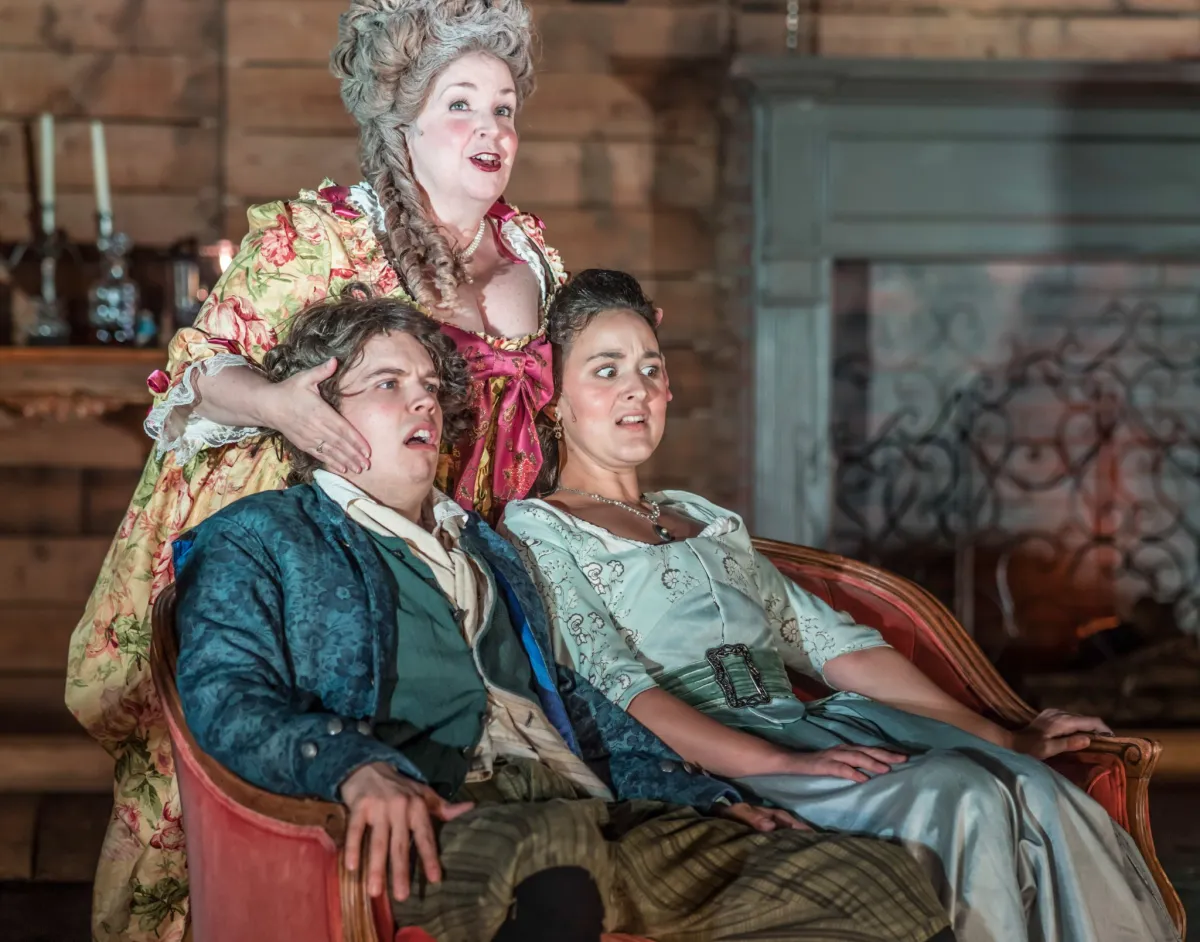
- The Hardcastle Home: A sprawling, old-fashioned, wood-paneled country mansion that feels centuries old. Because of its rustic, historical architecture, large hearths, and casual country hospitality, it is highly susceptible to being mistaken for an old, rambling wayside inn.
- The Three Pigeons: A smoky, raucous local alehouse where Tony Lumpkin spends his evenings drinking, singing, and gambling with low-born companions. It serves as the staging ground for the central deception.
2. Background and History
Context of 18th-Century Theatre
By 1773, the English stage was dominated by Sentimental Comedy (or comédie larmoyante—”weeping comedy”). Popularized by playwrights like Richard Cumberland and Hugh Kelly, these plays were highly moralistic, somber, and designed to make audiences weep over the virtues and misfortunes of the characters rather than laugh at human follies.
Goldsmith’s Manifesto
Oliver Goldsmith vehemently despised this trend, arguing in his famous 1773 essay, An Essay on the Theatre; or, a Comparison between Laughing and Sentimental Comedy, that the true purpose of comedy is to expose and laugh at the absurdities of human nature. He wrote She Stoops to Conquer as a direct counter-attack to restore Laughing Comedy to the stage.
Production and Reception
The play faced significant hurdles before its debut. George Colman, the manager of the Covent Garden Theatre, was convinced the play would be an utter failure because its humor was too low and farcical for polite society. Several lead actors even turned down their roles.
However, when it premiered on March 15, 1773, it was an instantaneous, massive success. Samuel Johnson, Goldsmith’s close friend and literary mentor, famously remarked: “I know no comedy for many years that has so much exhilarated an audience, that has answered so much the great end of comedy—making an audience merry.”
3. Comprehensive Summary
The play begins with Mr. and Mrs. Hardcastle arguing about their lifestyle. Mrs. Hardcastle longs for the high-fashion society of London, while her husband prefers the quiet, old-fashioned countryside. They also discuss their children: Kate, whom Mr. Hardcastle hopes to arrange a marriage with Charles Marlow (the son of his old friend); and Tony Lumpkin, Mrs. Hardcastle’s spoiled, rowdy son from a previous marriage, whom she desperately wants to marry off to her wealthy niece, Constance Neville, to keep Constance’s inheritance of jewels in the family. However, Tony and Constance secretly detest each other; Constance is deeply in love with Marlow’s traveling companion, George Hastings.
As Marlow and Hastings travel down from London, they get lost in the countryside as night falls. They stop at The Three Pigeons alehouse, where Tony Lumpkin realizes who they are. Sensing an opportunity for mischief, Tony tells the sophisticated travelers that they cannot possibly reach the Hardcastle estate tonight and directs them instead to a nearby inn—which is actually the Hardcastle mansion.
When Marlow and Hastings arrive at the inn, they treat Mr. Hardcastle not as a distinguished gentleman, but as an insolent, overbearing innkeeper, rudely demanding food, drink, and service. Mr. Hardcastle is profoundly shocked by Marlow’s apparent arrogance, unaware of the misunderstanding.
Meanwhile, Hastings encounters Constance and quickly realizes Tony’s trick. They decide to keep Marlow in the dark for a while because Marlow possesses a strange psychological split: he is paralyzed with shyness around high-born ladies but a charming rogue around lower-class women. If Marlow discovers he is at the Hardcastle home, his anxiety will cause him to flee immediately, ruining Hastings’ plan to elope with Constance.
When Marlow first meets Kate, he is so terrified that he cannot look her in the face, stammering his way through an incredibly awkward conversation. Later that evening, Kate changes out of her formal London gown into a simple, rustic dress at her father’s request. When Marlow encounters her in this attire, he mistakes her for a poor barmaid. Instantly dropping his stammer, he becomes incredibly confident, forward, and flirtatious, trying to kiss her. Kate, fascinated by this dual personality, decides to keep up the charade (“stooping”) to see his true character.
Chaos peaks when Tony helps Hastings steal Constance’s jewels from Mrs. Hardcastle’s bureau so the lovers can elope. When Mrs. Hardcastle discovers the theft, she panics and decides to hide Constance at a distant aunt’s house. Tony offers to drive their carriage, but instead drives his mother and Constance in circles for three hours in the dark, finally dumping his terrified mother in a horse pond at the back of their own garden, convincing her she has been attacked by highwaymen.
The truth is finally unveiled when Marlow’s father, Sir Charles, arrives at the estate. The two older gentlemen witness Marlow passionately declaring his love to Kate (whom he still believes is a barmaid). When Marlow finally realizes the “barmaid” is actually the high-born Miss Hardcastle, he is mortified but deeply in love. Tony is revealed to be of legal age, allowing him to officially reject Constance, freeing her to marry Hastings with her fortune intact. Marlow overcomes his dual nature, realizing that Kate matches both of his romantic ideals.
4. Key Themes
The Plasticity of Social Class and Behavior
The play argues that social class is largely a performance based on external cues. Marlow’s character shifts entirely depending on his perception of a woman’s social standing. He is incapable of seeing women as individuals; instead, he treats them according to their socio-economic caste. Kate’s ability to manipulate this shows that class markers (like clothing and accent) are easily fluid and performed.
Deception, Misprision, and Truth
Almost every character is engaged in some form of deception: Tony tricks the travelers, Kate plays a barmaid, Constance pretends to love Tony to pacify her aunt, and Hastings conceals the identity of the house. Goldsmith suggests that controlled deception is sometimes necessary to strip away artificial social masks and reveal underlying emotional truths.
The Hypocrisy of “Refinement” vs. Country Liberty
Goldsmith contrasts London’s rigid, artificial standard of “politeness” with the country’s raw, honest energy. Marlow’s sophisticated London upbringing has left him psychologically fractured and socially anxious. Conversely, the “low” characters like Tony Lumpkin and the rustic country setting provide the vitality, honesty, and quick wit needed to resolve the play’s deadlocks.
5. Detailed Acts and Scenes Explanation
Act I
- Scene 1 (The Hardcastle House): Establishes the domestic dynamics. We learn about the impending arrival of Marlow, the contrasting values of Mr. and Mrs. Hardcastle, and the secret romance between Constance and Hastings. Kate agrees to her father’s condition to wear simple country clothes in the evenings.
- Scene 2 (The Three Pigeons Alehouse): Introduces Tony Lumpkin in his true element—singing drinking songs with working-class locals. Marlow and Hastings arrive lost. Tony formulates his prank, setting the “Mistakes of a Night” in motion by misdirecting them to his stepfather’s house as an inn.
Act II
- Scene 1 (The Hardcastle House): Mr. Hardcastle tries to drill his rustic servants on how to behave like formal aristocratic attendants, resulting in comic chaos. Marlow and Hastings arrive and treat Hardcastle with astonishingly casual disrespect, ordering him around. Hastings then encounters Constance, discovers Tony’s trick, and they resolve to keep Marlow in the dark.
- The Marlow-Kate Interview: Marlow is introduced to Kate in her formal dress. He is unable to look her in the eye, stammers through half-sentences, and fails to notice her features. Tony and Hastings also interact, with Tony agreeing to help Hastings elope with Constance just to get rid of her.
Act III
- Scene 1 (The Hardcastle House): Mr. Hardcastle and Kate compare notes on Marlow. Hardcastle thinks he is the most impudent, rude young man alive; Kate thinks he is incredibly shy and timid. They realize they are talking about two completely different sides of the same man.
- Tony successfully steals Constance’s jewels from his mother’s cabinet and gives them to Hastings. When Constance asks her aunt to see the jewels, Mrs. Hardcastle lies and says they are missing, only to realize in horror a moment later that they actually are gone.
- Kate, now dressed in her plain country attire, encounters Marlow. He mistakes her for a barmaid, and his personality instantly flips into a swaggering, smooth-talking rake. Kate controls the interaction, testing his authentic feelings.
Act IV
- Scene 1 (The Hardcastle House): News arrives that Marlow’s father, Sir Charles, is coming, which threatens to blow the cover off the deception. Hastings has given the stolen jewels to Marlow for safekeeping; Marlow, still thinking he is at an inn, hands them directly to Mrs. Hardcastle (thinking she is the landlady) for safe storage.
- Hardcastle finally loses his temper with Marlow’s increasingly demanding behavior and orders him to leave his house. Marlow, confused, confronts Kate (as the barmaid) and discovers that the house is not an inn, but a private residence—though he still mistakenly thinks Kate is just a poor relative of the family. Mortified by his behavior toward Hardcastle, Marlow delivers a tender, genuine apology to Kate, showing real nobility of heart.
- Mrs. Hardcastle discovers Hastings and Constance’s plot to elope and vows to lock Constance up at Aunt Pedigree’s house.
Act V
- Scene 1 (The Hardcastle Garden): Sir Charles Marlow arrives, and he and Mr. Hardcastle laugh over the massive misunderstanding. However, Marlow denies ever being forward or romantic with Kate (since he only did so when he thought she was a barmaid). To prove Marlow’s true passions, Kate tells her father and Sir Charles to hide behind a screen and watch her next interaction with him.
- Scene 2 (The Back of the Garden): Tony arrives after his long carriage ride. He explains his ultimate prank: he drove his mother in circles for hours through mud and bogs, finally convincing her that they are on a dangerous, highwayman-infested heath miles away, when they are actually just forty yards from their own back door. Mr. Hardcastle steps out, exposing Tony’s ridiculous ruse to a terrified Mrs. Hardcastle.
- Scene 3 (The Parlor): The climax. Kate (acting as the poor relation/barmaid) meets Marlow. Hidden behind the screen, Sir Charles and Mr. Hardcastle watch as Marlow breaks through his class prejudices, falls to his knees, and offers to marry her despite her assumed poverty. The old men step out, the full truth is revealed, and Marlow realizes that his “barmaid” is the very lady his father chose for him. Mr. Hardcastle reveals that Tony has been of legal age for months; Tony immediately refuses Constance, clearing the path for her happy marriage to Hastings.
6. Major Character Sketches
Charles Marlow
Marlow is the psychological core of the play’s comedy, embodying a deep-seated 18th-century social anxiety. He is a split personality, torn between the rigid expectations of his aristocratic upbringing and his natural human desires.
- The Psychological Split: Around women of his own social standing (such as high-born ladies), Marlow suffers from a paralyzing, stammering shyness. He views them as fragile, moral icons to be venerated from afar, rendering him utterly speechless. Conversely, around women he perceives as lower-class (barmaids, servants), his class superiority releases his inhibitions. He becomes a confident, smooth-talking, and highly flirtatious rake.
- The Transformation: Marlow’s arc is about achieving psychological wholeness. By falling in love with Kate while believing she is a penniless barmaid, he learns to look past the superficial armor of class and rank. When he offers to marry her despite her lack of fortune, he proves that his core character is genuinely noble, moving from a superficial performance of class to authentic emotional maturity.
Miss Kate Hardcastle
Kate is the true orchestrator of the drama—intelligent, highly adaptable, and fiercely independent. She represents the ideal balance between the sophisticated wit of London high society and the practical honesty of the countryside.
- The Master Tactician: Unlike Marlow, who is a prisoner of social categories, Kate manipulates them with ease. Recognizing his dual nature, she assumes the role of a poor barmaid (“stooping”) to bypass his debilitating anxiety.
- Subverting Gender Norms: In a period where women were expected to be passive objects of courtship, Kate takes full control of her romantic destiny. She actively tests, analyzes, and “conquers” her future husband, forcing him to see her as a complex individual rather than a distant aristocratic symbol.
Tony Lumpkin
Tony is the play’s chaotic engine and primary source of physical, farcical humor. He is Mrs. Hardcastle’s spoiled son from a previous marriage—uneducated, loud, and entirely uninterested in the refined manners of the gentry.
- The Subversive Trickster: Although his mother views him as a hopeless child, Tony possesses a brilliant, pragmatic cunning. He completely rejects the elite London fashions and arranged marriages forced upon him, preferring the egalitarian camaraderie of the local alehouse.
- The Plot Driver: It is Tony’s initial lie at The Three Pigeons that sets the entire “Mistakes of a Night” in motion. His brilliant midnight carriage prank near the end of the play serves as a physical manifestation of his refusal to be controlled by his mother’s greedy ambitions.
Mr. Hardcastle
Mr. Hardcastle is a staunch, old-fashioned country gentleman who serves as a living monument to traditional English values.
- The Love of Antiquity: He famously declares his love for “everything that’s old: old friends, old times, old manners, old books, old wine.” He views the modern, fast-paced trends of London as vain and corrupting.
- The Comedic Foil: Hardcastle’s patience is pushed to its absolute limit as Marlow treats his home like a commercial tavern. His mounting indignation provides a sharp, ironic contrast to Marlow’s casual, entitled behavior, highlighting the complete breakdown of traditional hospitality under the weight of urban arrogance.
7. Literary Devices
Goldsmith employs a sophisticated array of classical dramatic and literary techniques to build tension and maximize comic effect:
- Dramatic Irony: This is the structural backbone of the play. The audience consistently possesses crucial information that the characters lack. We know the Hardcastle mansion is not an inn, that Kate is not a barmaid, and that Tony’s carriage ride is just a giant circle around the backyard. This knowledge creates a continuous sense of anticipation and humor.
- Mistaken Identity (Misprision): The plot relies heavily on characters misinterpreting their surroundings and each other based entirely on external cues (like clothing or location). Marlow mistakes a gentleman for an innkeeper and an heiress for a servant, proving how easily human perception is blinded by social assumptions.
- Satire: Goldsmith sharply satirizes the superficiality of the 18th-century upper classes. He mocks Mrs. Hardcastle’s desperate obsession with fleeting London fashion trends and exposes Marlow’s deeply hypocritical double standard in how he treats women based on their socio-economic status.
- Farcical Humor (Slapstick & Physicality): Alongside witty dialogue, the play uses physical comedy to break the stiff seriousness of the era’s theater. Tony dumping his mother into a muddy horse pond at the back of the estate is a classic farcical sequence that brings elite pretensions down to earth.
- The Wit of Dialogue (Repartee): The rapid-fire, sharp verbal sparring between Kate and Marlow (during her barmaid disguise) showcases Goldsmith’s mastery of language, where double meanings and subtext fly faster than the characters can consciously process them.
8. Social Issues Addressed in the Play
While She Stoops to Conquer is a lighthearted comedy, it holds up a mirror to the deeply entrenched systemic issues of 18th-century British society.
The Tyranny of Arranged Marriages & Parental Control
During the Georgian era, marriage among the gentry was treated as a cold financial transaction designed to consolidate wealth, land, and family status.
- Mrs. Hardcastle’s desperate attempt to force Tony and Constance into a marriage they both detest highlights the emotional cruelty of these practices.
- Goldsmith strongly advocates for marriages based on mutual affection, respect, and psychological compatibility, allowing both young couples to subvert parental dictates to find genuine love.
Class Stratification and the Performance of Rank
The play exposes the rigid, artificial barriers separating social classes. Marlow’s character reveals a dark truth about the aristocracy: they treat their social equals with forced, hyper-polite reverence, while viewing the working class as mere objects for exploitation or casual amusement. By showing that a noblewoman can effortlessly play a barmaid and win a gentleman’s heart, Goldsmith suggests that class distinctions are merely an external performance rather than an inherent indicator of human worth.
The Materialism of the Gentry
Wealth in the play is physically materialized in Constance Neville’s casket of jewels. The frantic shuffling of these jewels from drawer to drawer, their theft, and Mrs. Hardcastle’s complete psychological breakdown over their disappearance satirizes the upper class’s obsessive dependency on material wealth. Human relationships and happiness are consistently jeopardized for the sake of portable property.
The Urban-Rural Divide (Town vs. Country)
The play addresses the growing cultural chasm between London (the hub of modern fashion, superficial politeness, and snobbery) and the Countryside (often dismissed by Londoners as boorish, muddy, and backwards). Goldsmith subverts this hierarchy entirely. The London travelers are shown to be arrogant, anxious, and easily fooled, while the country residents possess the vitality, quick wit, and fundamental honesty required to untangle the night’s chaos.
9. Frequently Cited Quotations
1. Mr. Hardcastle
On the Corruption of Modern London
“I love everything that’s old: old friends, old times, old manners, old books, old wine; and, I believe, Dorothy, you’ll own I have been pretty fond of an old wife.”
(Act I, Scene 1)
- Context: Mr. Hardcastle is arguing with his wife, Dorothy, about her desperate desire to visit London and adopt the latest city fashions.
- Explanation: This quote encapsulates Mr. Hardcastle’s entire worldview and serves as a thesis statement for the Town vs. Country theme. He values stability, history, and authentic English traditions over the superficial, fast-changing whims of London high society. Goldsmith uses this line to establish the rustic, honest, and grounded nature of the country gentry, immediately contrasting it with the urban pretension that arrives later in the play.
On Marlow’s Arrogance
“This may be modern modesty, but I never saw anything look so like old-fashioned impudence.”
(Act II, Scene 1)
- Context: Mr. Hardcastle is speaking as an aside to the audience after Marlow has rudely ordered him around, criticized his house, and demanded drink, all while completely ignoring Hardcastle’s attempts at polite conversation.
- Explanation: This line beautifully highlights the dramatic irony driving the plot. Marlow has been described to Hardcastle as a man of exceptional “modesty” and shyness. Because Marlow thinks he is at an inn, he acts with the casual, entitled authority of a wealthy customer. Hardcastle, unaware of Tony’s prank, interprets Marlow’s behavior as staggering disrespect. The quote satirizes how modern “refined” city manners can easily mask blatant arrogance.
2. Kate Hardcastle
Defining the Play’s Strategy
“I’ll still preserve the character in which I stooped to conquer, but will undeceive my papa, who, perhaps, may mistake my delaying for compliance.”
(Act IV, Scene 1)
- Context: Kate is speaking to herself after Marlow has discovered that the house is a private residence, though he still believes Kate is a poor, low-born relation or barmaid working there.
- Explanation: This line explicitly provides the title of the play and defines Kate’s tactical genius. To “stoop” means to lower one’s social status, and to “conquer” means to win Marlow’s heart and expose his true character. Kate recognizes that if she reveals her true identity as an wealthy heiress too soon, Marlow’s paralyzing upper-class social anxiety will return, causing him to flee. By maintaining her low-born disguise, she keeps him comfortable enough to woo her authentically, taking complete agency over her romantic destiny.
3. Charles Marlow
On His Paralyzing Social Anxiety
“To me, a modest woman, drest out in all her finery, is the most tremendous object of the whole creation.”
(Act II, Scene 1)
- Context: Marlow is explaining his peculiar psychological affliction to his friend Hastings as they prepare to meet Miss Hardcastle.
- Explanation: This line exposes the class-based double standard and psychological split within Marlow. He views aristocratic women in formal gowns not as human beings, but as terrifying, untouchable icons of morality (“tremendous objects”). This hyper-reverence paralyzes his speech. Goldsmith uses this to mock the artificiality of 18th-century courtship rituals, which turned elite women into distant monuments, preventing genuine human connection.
Breaking Through Class Prejudices
“What at first seemed modesty in you, now appears refined sentiment. What at first was liking, is now grown into adoration. As the world goes, every day shows me the absurdity of my passion, but I have resolved to be guided by it.”
(Act V, Scene 3)
- Context: Marlow is passionately declaring his love to Kate while she is still disguised as a poor, penniless relation. He is on his knees, fully prepared to marry her despite knowing his father and society will disapprove of her lack of wealth and status.
- Explanation: This is Marlow’s ultimate moment of character growth and the emotional climax of the play. He completely sheds his class snobbery and urban superficiality. By choosing “adoration” and genuine emotion over the “absurdity” of rigid social expectations, he proves his internal nobility. Witnessing this confession from behind a screen allows Mr. Hardcastle and Sir Charles to happily bless the union, resolving the central conflict.
4. Tony Lumpkin
On Formal Education and Freedom
“Let school-masters puzzle their brain, / With grammar, and nonsense, and learning; / Good liquor, I stoutly maintain, / Gives genius a better discerning.”
(Act I, Scene 2)
- Context: Tony sings this song to his working-class companions at The Three Pigeons alehouse before the arrival of Marlow and Hastings.
- Explanation: This lyric establishes Tony as the ultimate subversive trickster and champion of Laughing Comedy. He rejects the stiff, moralistic, and intellectual expectations of the upper classes (represented by “grammar and nonsense”). Instead, he aligns himself with the raw, celebratory, and democratic energy of the tavern. This song sets the tone for the farcical chaos Tony is about to unleash on the sophisticated London travelers, proving that rustic wit can easily outsmart city education.
Aman Pal
Literatureman