
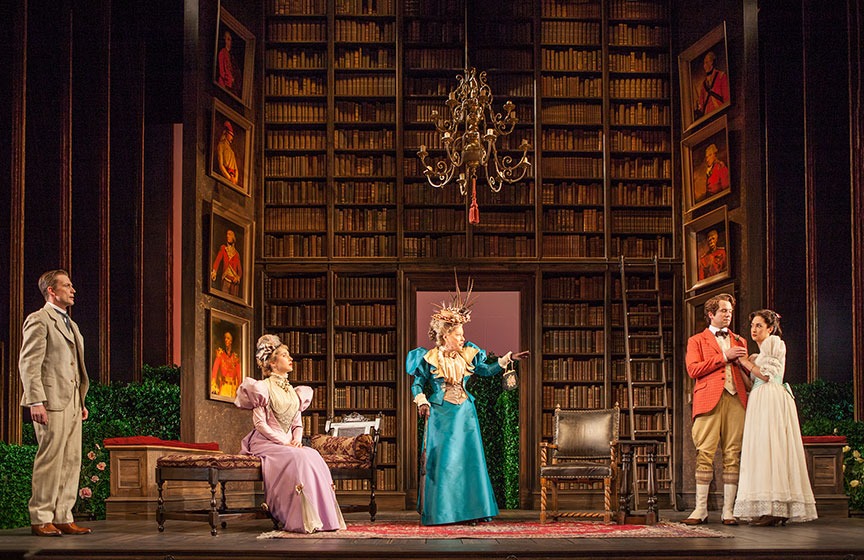
Oscar Wilde’s The Importance of Being Earnest (1895) is the definitive masterpiece of the Comedy of Manners genre. Subtitled “A Trivial Comedy for Serious People,” the play is a razor-sharp satire of Victorian social hypocrisies, packaged in sparkling wit, absurd plot twists, and brilliant wordplay.
Contents
1. Background and History
Historical Context
The play premiered on February 14, 1895, at the St. James’s Theatre in London. This was the twilight of the Victorian era, a period defined by intense social conservatism, strict moral codes, and an obsession with duty, respectability, and social class.
Aestheticism
Wilde was a leading figure in the Aesthetic Movement, which championed the philosophy of “art for art’s sake”—the idea that art should exist purely for its own beauty and entertainment value, rather than to deliver moral lectures. Earnest is the ultimate manifestation of this philosophy; it treats profound social constructs with absolute levity.
A Bittersweet Triumph
While the opening night was a massive success, the play’s history is deeply tied to Wilde’s personal tragedy. The Marquess of Queensberry—the father of Wilde’s lover, Lord Alfred Douglas—planned to disrupt the premiere with a bouquet of vegetables. Wilde barred him from the theater, sparking a chain of events that led to Wilde’s arrest, trial, and eventual imprisonment for “gross indecency” just three months later. The play closed after only 86 performances, marking both the pinnacle and the collapse of Wilde’s career.
2. Setting: The Social Divide
The play’s setting structurally reflects the dual lives of its main characters. It moves from the high-society urban sprawl of London to the idealized, peaceful country estate.
- Act I: Algernon’s Flat in Mayfair, London: Mayfair was (and is) one of London’s wealthiest districts. The setting represents artificiality, sophisticated decadence, superficial gossip, and the rigid social expectations of the “Season” (the period when upper-class families gathered in the city for balls and social networking).
- Acts II & III: The Manor House, Woolton, Hertfordshire: The country setting represents pastoral innocence, duty, and morality on the surface. Jack uses this space to pretend to be a responsible, serious moral guardian to his ward, Cecily. However, Wilde quickly exposes that the country is just as full of deception, fantasy, and triviality as the city.
3. Major Character Sketches
| Character | Role / Archetype | Key Characteristics |
| John Jack Worthing | The hypocritical moralist | A respectable country gentleman who pretends to have a rebellious, tragic younger brother named “Ernest” so he can escape to London whenever he wants to misbehave. He is desperate to marry Gwendolen but lacks the pedigree required by high society, having been found as a baby in a handbag. |
| Algernon Algy Moncrieff | The unapologetic dandy | Jack’s urban, brilliant, and deeply cynical friend. Unlike Jack, Algy is a dedicated “Bunburyist”—someone who has invented an invalid friend named Bunbury to avoid boring social obligations. He lives for pleasure, art, and food, and falls instantly for Cecily’s whimsical nature. |
| Gwendolen Fairfax | The sophisticated metropolitan | Lady Bracknell’s daughter. She is entirely driven by style, fashion, and urban refinement. She insists she could only love a man named Ernest, proving she values aesthetic concepts far above actual character traits. |
| Cecily Cardew | The imaginative romantic | Jack’s 18-year-old ward in the country. Outwardly sweet and sheltered, she is actually brilliantly manipulative and bored by her studies. She lives in a world of romantic fiction, even going so far as to write love letters to herself from Algy (whom she thinks is “Ernest”) before she ever meets him. |
| Lady Bracknell | The ultimate Victorian gatekeeper | Algernon’s aunt and the play’s comedic force. She represents the tyrannical, mercenary, and deeply hypocritical nature of the Victorian upper class. To her, marriage is not about love; it is a legal and financial transaction based entirely on wealth, titles, and social connections. |
4. Major Themes
The Critique of Progress and Class
Through Lady Bracknell, Wilde targets the absurd standards of the aristocracy. When interviewing Jack for marriage, she is thrilled to hear he smokes (calling it an occupation) and states that an aristocratic education should do absolutely nothing to cultivate the mind, lest it threaten the social order.
Marriage as a Social and Economic Tool
In the world of Earnest, marriage has nothing to do with romance. It is treated as a business deal. Lady Bracknell meticulously evaluates bank accounts and family trees, while Gwendolen and Cecily focus entirely on the aesthetic appeal of their suitors’ names.
The Double Life (“Bunburying”)
Both male leads invent alternative personas to escape social confines. “Bunburying” highlights the intense pressure of Victorian morality. Wilde suggests that the only way to survive the crushing weight of public respectability is to cultivate a secret, rebellious private life.
The Fluidity of Truth vs. Fiction
Wilde constantly flips the concepts of honesty and deceit. Characters lie to achieve their goals, yet their fictions consistently turn into realities. Cecily’s invented diary entries become a real engagement, and Jack’s fake name turns out to be his actual birth name.
5. Acts and Scenes Explanation
Act I: London (Algernon’s Flat)
The play opens with Algernon playing the piano badly and chatting with his butler, Lane, immediately setting a tone of relaxed privilege. Jack arrives from the country intending to propose to Gwendolen, but Algy confronts him with a cigarette case inscribed to “Uncle Jack” from “Little Cecily.” Jack is forced to confess his double life: he is Jack in the country and Ernest in the city.
Lady Bracknell and Gwendolen arrive. Jack proposes to Gwendolen, who accepts because she thinks his name is Ernest. However, Lady Bracknell fiercely rejects the match during a famous interview when she discovers Jack was a foundling left in a leather handbag at Victoria Station. Algy, overhearing Jack mention his country address and his wealthy young ward Cecily, secretly notes down the location, planning a “Bunburying” trip of his own.
Act II: The Country (The Manor House Garden)
We meet Cecily and her governess, Miss Prism. Algy arrives unannounced, pretending to be Jack’s wicked brother “Ernest.” He is instantly enchanted by Cecily, and she reveals she has already been in love with his persona for months. Meanwhile, Jack returns early dressed in full mourning clothes, claiming his brother “Ernest” has died in Paris from a severe chill. His plan to kill off his alter-ego is instantly ruined when he discovers Algy alive and well, pretending to be that very brother.
Gwendolen arrives to visit Jack. She and Cecily have tea in the garden. Over tea, they discover that both believe they are engaged to the same man: “Ernest.” A wonderfully polite, passive-aggressive conflict ensues over tea and cake. The tension breaks when Jack and Algy enter, and their true identities are revealed. The women, realizing they have been deceived, bond over their shared anger and retreat into the house, leaving the men to squabble over eating muffins.
Act III: The Country (Inside the Manor House)
The women forgive the men after Jack and Algy reveal they have both scheduled emergency christenings with the local vicar, Dr. Chasuble, to change their legal names to Ernest. Lady Bracknell arrives to retrieve Gwendolen and discovers Algy’s engagement to Cecily. She initially refuses to consent until she learns of Cecily’s massive inheritance. Jack, as Cecily’s guardian, retaliates by refusing to let Cecily marry Algy unless Lady Bracknell allows him to marry Gwendolen.
The deadlock is broken by the arrival of Miss Prism. Lady Bracknell recognizes her as a former family nurse who, 28 years ago, went out for a walk with a baby in a baby carriage and never returned. Miss Prism tearfully confesses that in a moment of distraction, she placed the manuscript of a three-volume novel she was writing into the baby carriage, and accidentally put the baby into her leather handbag, leaving it at Victoria Station.
Jack realizes he was that baby. He rushes upstairs, retrieves the handbag, and proves he is actually Lady Bracknell’s nephew—and therefore Algernon’s older brother. He consults the army lists to find his birth father’s name, discovering that his name truly is, in fact, Ernest. The play ends with a flurry of embraces as Jack tells Lady Bracknell that he has finally realized “the vital Importance of Being Earnest.”
6. Social Issues Targeted by Wilde
While The Importance of Being Earnest feels lighthearted, it is a devastating critique of late-Victorian society. Wilde uses farce to expose several deep cultural anxieties.
The Tyranny of Social Class & Pedigree
Victorian high society was fiercely protective of its boundaries. Your worth was determined entirely by birth, titles, and ancestral land. Wilde exposes the absurdity of this system by making Jack—a man who has all the wealth, manners, and morality of a gentleman—completely unacceptable simply because his “lineage” is a leather handbag found at a railway station.
The Restrictive Gender Roles
Victorian society promoted the ideal of “Separate Spheres”: men belonged in the public world of politics and business, while women belonged in the private, domestic sphere as moral guardians. Wilde gleefully flips this. In the play, the women (Lady Bracknell, Gwendolen, Cecily) are fiercely commanding, analytical, and controlling, while the men (Jack, Algy) are passive, weak, and obsessed with trivial things like muffins and clothes.
Shallow Moral Hypocrisy
The Victorians publicly obsessed over “earnestness”—being serious, duty-bound, and morally upright. Wilde shows that this public piety was an act. To survive this suffocating expectation, men like Jack and Algy are forced to create alternate, degenerate personas (“Bunburying”) just to breathe. Wilde argues that Victorian morality actually creates dishonesty.
7. Literary Devices
Wilde’s comedic engine relies on specific, repeating linguistic patterns. Here are the most prominent devices used throughout the text:
Epigrams
An epigram is a short, sharp, and satirical statement that typically ends with an unexpected, witty twist. Wilde is the undisputed king of the epigram.
- Example: “Divorces are made in Heaven.” (Algy)
- Function: It catches the audience off guard by taking a traditional social belief and completely reversing it.
Paradox
A paradox is a statement that seems self-contradictory or absurd on the surface, but actually reveals a deeper, hidden truth.
- Example: “It is awfully hard work doing nothing.” (Algy)
- Function: It highlights the exhausting nature of the upper-class lifestyle, where maintaining a facade of elegant leisure takes immense effort.
Dramatic Irony
This occurs when the audience knows a vital piece of information that the characters on stage do not.
- Example: In Act II, when Jack arrives clad in black mourning clothes to weep over his brother Ernest’s “death,” the audience is already laughing because we know Algy is inside the house actively pretending to be Ernest.
- Function: It heightens the farce and keeps the pacing incredibly fast and chaotic.
Satire and Parody
Wilde parodies the popular melodrama plays of his era. He uses standard dramatic tropes—secret identities, long-lost babies, diaries, and forbidden love—but treats them with absolute triviality to show how ridiculous conventional theater (and society) can be.
8. Important Quotations & Explanation
“I hope you have not been leading a double life, pretending to be wicked and being really good all the time. That would be hypocrisy.”
— Cecily (Act II)
- Explanation: This is a classic Wildean paradox. In Victorian society, hypocrisy meant pretending to be good while actually being wicked. Cecily completely inverts this, suggesting that pretending to be bad while actually being good is the real deception. It highlights her romantic fantasy world where “wickedness” is highly attractive and exciting.
“To lose one parent, Mr. Worthing, may be regarded as a misfortune; to lose both looks like carelessness.”
— Lady Bracknell (Act I)
- Explanation: Delivered during Jack’s marriage interview, this is perhaps the most famous line in the play. It perfectly encapsulates Lady Bracknell’s complete lack of empathy and her rigid, transactional worldview. She treats the tragic, involuntary reality of being an orphan as a failure of manners and organization, proving how cold and out-of-touch the aristocracy is.
“The truth is rarely pure and never simple. Modern life would be quite tedious if it were either, and modern literature a complete impossibility!”
— Algernon (Act I)
- Explanation: This quote serves as the philosophical backbone of the play. Algy is responding to Jack’s desire to kill off his alter-ego and tell Gwendolen the whole truth. Algy argues that deception and complexity are what make life entertaining and art possible. It directly supports Wilde’s Aesthetic philosophy that art and life should prioritize beauty and amusement over dry, simple facts.
“In matters of grave importance, style, not sincerity, is the vital thing.”
— Gwendolen (Act III)
- Explanation: This line summarizes the ultimate critique of the Victorian upper class. Gwendolen explicitly states that how something looks matters infinitely more than the truth behind it. Sincerity is dismissed as trivial, while outward appearance, fashion, and superficial manners are elevated to matters of “grave importance.”
“I’ve now realized for the first time in my life the vital Importance of Being Earnest.”
— Jack (Act III)
- Explanation: The brilliant closing line of the play hinges on a massive pun. For the entire play, Jack was lying about his name being Ernest, yet he accidentally stumbled into the truth. By saying this, he isn’t actually promising to be a moral, “earnest” person in the future; rather, he is celebrating the fact that his name is Ernest, which allows him to marry Gwendolen. It is Wilde’s final joke: the ultimate reward goes to the man who lied his way into the truth.
9. Comedy of Manner
It is a specific genre of satire that makes fun of the behavior, manners, and unspoken codes of a highly sophisticated, wealthy social class. Rather than relying on physical slapstick, its comedy comes from verbal wit, sharp insults, and the chaotic clash between public respectability and private desire.
Oscar Wilde’s The Importance of Being Earnest is widely considered the absolute pinnacle of this genre. Here is how the play operates as a perfect Comedy of Manners:
1. The Targets: Etiquette and High Society
In a Comedy of Manners, the plot is driven by the ridiculous rules of the aristocracy. Wilde doesn’t mock the characters for being evil; he mocks them for being superficial.
- The Comedy: Social catastrophes are redefined. For Lady Bracknell, being an orphan isn’t a tragedy—it is “carelessness.” For Gwendolen and Cecily, a man’s character doesn’t matter at all, so long as his name is Ernest.
- The Focus: The play focuses on the supreme importance of trivial things (like cucumber sandwiches, tea-table etiquette, and muffins) while treating actual serious matters (like death, illness, and marriage) as minor inconveniences.
2. Wit as a Weapon
The defining feature of the genre is witty dialogue. Characters in Earnest don’t talk like real people; they speak in highly polished, perfectly rhythmic epigrams and paradoxes. In this upper-class world, the person who wins the argument is not the person who is morally right, but the person who delivers the sharpest, most elegant line.
3. The Central Deception (The “Secret”)
Comedies of Manners almost always feature characters leading double lives or hiding secrets to bypass the crushing weight of social expectations. Jack and Algernon create “Ernest” and “Bunbury” specifically because the social manners of their world are too suffocating to endure without a cheat code. The humor comes from watching them desperately juggle these fake identities to maintain their flawless public reputations.
In Short: The Importance of Being Earnest captures the very essence of the Comedy of Manners by holding up a funhouse mirror to the Victorian elite, showing a world where style completely triumphs over substance, and where good manners are used to mask total absurdity.
Aman Pal
Liteartureman