
John Millington Synge’s Riders to the Sea (1904) stands as a monument of modern drama, compressing the vast, terrifying scope of an epic struggle between humanity and nature into a single, flawless act.
Here is a structured, comprehensive analysis broken down by setting, background, character profiles, themes, and structural breakdown.
Contents
1. Setting
The setting of Riders to the Sea acts as an oppressive character in its own right, directly dictating the physical and psychological realities of the play.
- Geographic Isolation: The play is set in an island cottage on the Inishmaan island—the middle of the three Aran Islands situated off the storm-battered west coast of Ireland. Cut off from the mainland, the islanders are completely vulnerable to the elements.
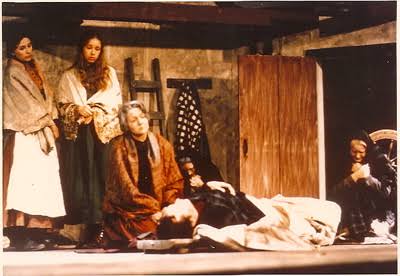
- The Cottage Interior: The domestic space is deliberately sparse and functional, filled with objects that foreshadow death: nets, oilskins, spinning wheels, a new rope, and white wooden boards leaning against the wall. The boundary between life inside and the deadly sea outside is thin, porous, and constantly threatened by the howling wind.
- Atmospheric Terror: The omnipresent sound of the Atlantic Ocean surrounds the performance. It serves as an unyielding, indifferent prison and graveyard that completely dominates the characters’ consciousness.
2. Background and History
Understanding the historical context of the Irish Literary Renaissance clarifies Synge’s artistic intentions.
- The Revivalist Movement: Around the turn of the 20th century, Irish intellectuals—led by figures like W.B. Yeats, Lady Gregory, and Edward Martyn—sought to forge a distinct national literature. They wanted to move away from British colonial stereotypes and revive indigenous Irish folklore, culture, and language.
- Yeats’s Advice: In 1896, W.B. Yeats met a young J.M. Synge in Paris and gave him a famous piece of advice: “Go to the Aran Islands. Live there as if you were one of the people themselves; express a life that has never find expression in literature.” Synge took this to heart, spending his summers between 1898 and 1902 living among the islanders.
- Socio-Economic Reality: The real-world Aran Islanders lived an incredibly primitive, hardscrabble life. They grew potatoes in shallow soil made from sand and seaweed, and the men harvested the sea using currachs (lightweight canvas-and-tar boats). Drownings were a common, recurring feature of life, which Synge recorded firsthand in his travelogue, The Aran Islands.
3. Major Character Sketch
| Character | Psychological Profile | Dramatic Function |
| Maurya | An old, physically exhausted matriarch. She has been systematically stripped of her family, having already lost her husband, father-in-law, and five sons (Murtough, Seamus, Ting, Walter, and Michael) to the sea. She is deeply superstitious, operating entirely on intuition, folklore, and premonitions. | She functions as the archetypal universal tragic mother. Her emotional journey moves from debilitating terror to a state of sublime, stoic composure once she has nothing left to lose. |
| Bartley | Maurya’s last surviving son. He is pragmatic, driven, and relatively quiet. He does not ride out to sea out of bravado, but out of absolute economic necessity; he must cross to the mainland to sell horses at the Galway fair to pay for the family’s upkeep. | He represents the doomed breadwinner. He embodies the quiet, tragic courage of the island men who consciously face death every single day simply to survive. |
| Cathleen | Maurya’s eldest daughter (around twenty years old). She is sensible, highly organized, and actively manages the household—spinning wool, baking bread, and identifying the clothing of her drowned brother. | She represents practical resilience. She serves as a vital bridge between Maurya’s ancient fatalism and the day-to-day realities of keeping the family alive. |
| Nora | Maurya’s younger daughter. She is observant, deeply empathetic, and acts as the family’s scout, bringing in news from the outside world and checking on the young priest’s updates. | She provides the emotional lens through which the audience witnesses the unfolding domestic dread, balancing her sister’s stoic practicality. |
4. Major Themes
The Sea as an Absolute Antagonist
The sea in this play functions as a pagan god—omnipotent, pitiless, and completely indifferent to human grief. It cannot be bartered with, defeated, or reasoned with. Human agency is rendered completely meaningless against its absolute dominance.
Pagan Fatalism vs. Christian Hollow Promises
A profound tension exists between traditional Celtic paganism (manifested in Maurya’s visions and omens) and Catholic orthodoxy (represented by the off-stage young priest). The daughters try to comfort themselves with the priest’s assurances that “Almighty God won’t leave her destitute with no son living.” However, Maurya’s experience proves that the ancient, primordial laws of nature easily overpower the comforts of the institutional Church.
Material Culture as Symbolic Prophecy
Everyday domestic objects are loaded with heavy, claustrophobic symbolism:
- The White Boards: Initially bought to build a coffin for Michael if his body is recovered, they are ultimately used for Bartley.
- The Fine Red Sail: Symbolizes the fleeting vitality of the island men.
- The New Rope: Bought by Bartley to make a halter for his horse, it is eventually used to lower his own corpse into the earth.
5. Scene-by-Scene Explanation
Riders to the Sea is a one-act play, but its narrative shifts organically through distinct movements that mirror the structure of a full five-act classical tragedy.
Movement 1: The Domestic Omen (Exposition)
The play opens with Cathleen kneeling at her spinning wheel and Nora entering with a hidden bundle given to her by the young priest. The bundle contains clothes stripped from a drowned man found far north in Donegal. They hide the bundle in the turf-loft, terrified that their mother will see it and realize their brother Michael is officially dead. They discuss the immediate danger: the weather is turning treacherous, yet their last brother, Bartley, is determined to catch the steamer to the mainland to sell their horses.
Movement 2: The Departure and the Unspoken Curse (Rising Action)
Maurya enters, anxious and restless. Bartley arrives soon after, urgently looking for the new rope to make a halter. Ignoring his mother’s desperate pleas about the incoming storm and her dark forebodings, Bartley puts on his old coat and prepares to lead his two horses down to the boat.
When he leaves, Maurya refuses to give him her blessing—an act that, in island culture, functions as an unintended curse. Realizing the gravity of this omission, Cathleen sends Maurya down to the well with a piece of bread to intercept Bartley, give him the food, and deliver her blessing.
Movement 3: The Vision at the Well (Climax)
While Maurya is gone, Cathleen and Nora frantically retrieve the bundle of clothes from the loft. By counting the stitches on a stocking, Nora recognizes her own handiwork; they confirm with absolute certainty that Michael has drowned.
Maurya returns, shaking with terror, the bread still in her hand. She reveals that she saw Bartley riding the red mare, but right behind him, riding the grey pony, was the ghost of Michael dressed in fine clothes. Maurya realizes this vision is an absolute death sentence for Bartley:
“I’ve seen the fearfulest thing any person has seen since the day Brydone was drowned of a straying wall.”
Movement 4: The Lamentation (Falling Action)
Even as Maurya details her past losses—recollecting how her husband and sons were carried into the cottage dripping with seawater years ago—the sound of crying is heard from the shore. The village women begin to trickle into the cottage, falling to their knees and performing the keen (a traditional, rhythmic Irish vocal lament for the dead).
Movement 5: Sublime Resignation (Resolution)
Men enter carrying a dripping stretcher. Bartley has been knocked off the rocks by the grey pony and drowned in the surf. Instead of collapsing into hysterics, Maurya experiences a profound, transcendent peace.
She drops to her knees, pours holy water over Bartley’s body, and turns her empty cup upside down. The sea has finally taken everything she loves; it has no power left to hurt her. The play ends on her quiet, fatalistic benediction: “No man at all can be living for ever, and we must be satisfied.”
To complete your comprehensive framework for analyzing J.M. Synge’s Riders to the Sea, we need to dive into the core socio-cultural issues, the exact stylistic tools Synge uses to elevate the prose, and the pivotal text quotes that ground these concepts.
6. Key Socio-Cultural & Literary Issues
Economic Precarity and Subsistence Living
The tragedy of the play is driven entirely by poverty. Bartley doesn’t ride out into the storm out of hubris or stubbornness; he goes because the family’s survival depends on the four pounds he might get for the horses at the Galway fair. Synge highlights a brutal loop: the men must risk their lives on the sea to afford to live on the land, and the land itself is so barren that it cannot support them without the sea.
The Erasure of the Patriarchy
A striking structural issue in the play is the complete absence of adult men in the domestic sphere. The household is an entirely matriarchal space run by Maurya, Cathleen, and Nora. The patriarchy has been literally swallowed by the sea. When Bartley dies, the family is left with no male protector, which, in 1904 rural Ireland, meant total socioeconomic ruin.
The Isolation of Marginalized Communities
Synge captures the profound geographic and psychological isolation of the Aran Islands. The community is cut off not just from the mainland, but from the entire trajectory of modern, industrializing Europe. This extreme isolation forces the characters to rely on a insular, communal form of survival, where grief is shared collectively through rituals like the keening (traditional vocal mourning).
7. Literary & Dramatic Devices
- Dramatic Irony: The audience and the daughters realize Michael is dead well before Maurya does. When Maurya returns from the well lamenting her vision of Michael’s ghost, the audience already knows his actual clothes are sitting on the kitchen table. This creates an unbearable sense of anticipation for Bartley’s inevitable fate.
- Foreshadowing (Prolepsis): Synge uses physical props to map out the narrative trajectory before it happens.
- The white boards purchased for Michael’s coffin end up housing Bartley.
- The new rope meant for a halter becomes the rope used to lower Bartley into his grave.
- Maurya says, “In the night I hear the surf on the white rocks, and there is great stirring in the world.”
- Hiberno-English (Dialect as Art): Synge does not use standard English; he translates Gaelic syntax into English words. This creates a rhythmic, poetic cadence full of inversions (e.g., “Is it crying you are?” or “It’s a hard thing they’ll be saying”). It strips away drawing-room pretense and lends the peasant dialogue the weight of Biblical verse.
- The “Keen” as Dramatic Chorus: The entrance of the island women who chant the traditional keen functions exactly like a Chorus in classical Greek tragedy. They do not drive the plot forward; instead, they provide a haunting, non-verbal commentary on the inevitability of human suffering.
8. Important Quotations & Explanations
Here are the most critical lines from the play, broken down by their context and deeper thematic value:
Quote 1: The Hollow Promise of Orthodoxy
Nora: “And the young priest said he’d a right to bid hers stay at home this night, but ‘Ah,’ says he, ‘it’s little used she’ll be to an old woman’s crying, and I won’t stop him,’ says he, ‘for Almighty God won’t leave her destitute with no son living.'”
- Context: Early in the play, Nora explains to Cathleen why the young priest refused to stop Bartley from going to sea.
- Explanation: This quote sets up the central ideological conflict. The young priest’s naive, institutional faith in a protective Christian God stands in direct, ironic contrast to the reality of the play. It proves how detached the institutional Church is from the harsh, ancient laws of the Atlantic, which do, in fact, leave Maurya completely destitute.
Quote 2: The Futility of the Blessing
Maurya: “I went down to the spring well, and I stood there saying a prayer to myself, and Bartley came along and he riding on the red mare with the grey pony behind him… I seen Michael myself… with fine clothes on him, and new shoes on his feet.”
- Context: Maurya returns from the spring well, terrified and trembling, after failing to give Bartley her blessing.
- Explanation: This is the dramatic climax of the play’s symbolism. The “grey pony” is a universal folkloric emblem of death (the pale horse of the Apocalypse). Seeing Michael in “fine clothes” and “new shoes” indicates that he has already been prepared for burial by the sea. This vision confirms that the boundary between the living and the dead has collapsed, sealing Bartley’s fate.
Quote 3: Tragic Catharsis & Radical Peace
Maurya: “They’re all gone now, and there isn’t anything more the sea can do to me… I won’t be care-calling after the priest on a night with a great wind crying from the west… It’s a great rest I’ll have now, and it’s time surely.”
- Context: Spoken right after Bartley’s dripping body is carried into the cottage.
- Explanation: This is one of the most famous monologues in modern theater. Maurya achieves a radical, paradoxical peace. Her terror is gone because her vulnerability is gone—the sea has exhausted its capacity to hurt her. She no longer needs to pray, watch the weather, or beg priests for help. Her stoic resignation elevates her from a victim of circumstance to a timeless figure of monumental dignity.
Quote 4: The Final Fatalistic Verdict
Maurya: “Michael has a clean burial in the far north, and Bartley will have a fine coffin out of the white boards, and a deep grave surely. What more can we want than that? No man at all can be living for ever, and we must be satisfied.”
- Context: The final lines of the play as Maurya drops her hands over the dead Bartley.
- Explanation: The phrase “we must be satisfied” is the ultimate expression of tragic resignation. In the islanders’ world, a “fine coffin” and a “deep grave” on dry land are the highest luxuries a family can hope for, given that most men are lost to the sea without a trace. Maurya accepts human mortality not with despair, but with a quiet, devastating equanimity.
Aman Pal
Literatureman