
“London, 1802” is one of Wordsworth’s most passionate political and moral outcries. Written in the traditional Petrarchan sonnet form, it serves as an elegy for a lost English identity and a desperate prayer for national rebirth.
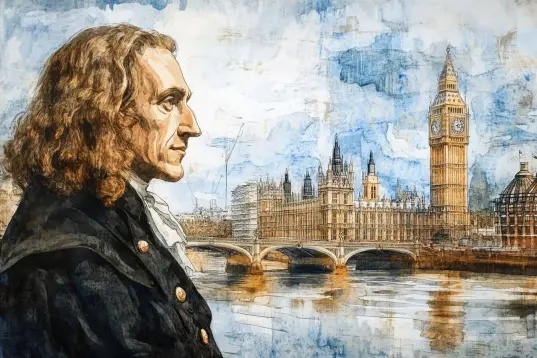
Here is a comprehensive breakdown of the poem, structured for deep textual analysis.
Contents
I. Introduction
Context and Composition
Wordsworth drafted this sonnet in late 1802, shortly after returning from a brief visit to France. The stark contrast between the revolutionary fervor on the continent and what he perceived as the cold, commercial complacency of England deeply unsettled him.
The Core Theme
The poem operates on a central paradox: to move forward into the modern world, England must look backward to its past. Wordsworth diagnoses his contemporary society as spiritually bankrupt, stripped of its ancient virtues by the rise of industrialization, urban migration, and raw capitalism. To cure this malaise, he invokes the ghost of John Milton, the 17th-century epic poet, radical republican, and theologian, viewing Milton not just as a literary master but as the ultimate symbol of English moral integrity, duty, and spiritual freedom.
II. Line-by-Line Analysis
The sonnet follows a strict structural division: the octave (first 8 lines) presents the problem (England’s decay), while the sestet (remaining 6 lines) offers the remedy (Milton’s virtues).
The Octave: The Diagnosis of Decay
Line 1: “Milton! thou shouldst be living at this hour:”
The poem opens with an immediate, dramatic apostrophe (a direct address to an absent or dead person). By placing “Milton!” as a spondee at the very beginning, Wordsworth disrupts the standard iambic meter to create an urgent, ringing command. The exclamation establishes that the current crisis is so profound that only a voice of monumental authority can address it.
Line 2: “England hath need of thee: she is a fen”
The caesura (the pause after “thee”) forces a sharp transition from the idealized figure of Milton to the grim reality of the nation. England is personified as a female entity in distress. Wordsworth introduces a devastating metaphor: she is a “fen”—a low, marshy, waterlogged wetland.
Line 3: “Of stagnant waters: altar, sword, and pen,”
The fen metaphor is completed with “stagnant waters,” implying a lack of movement, growth, and spiritual vitality. Wordsworth then deploys metonymy to list the foundational pillars of English institutional life:
- Altar: The Church / religion.
- Sword: The military / state power.
- Pen: Literature / intellectual life.
Line 4: “Fireside, the heroic wealth of hall and bower,”
The list of institutional pillars continues into the private sphere:
- Fireside: The domestic home and family unit.
- Hall and bower: The nobility (“hall”) and the pastoral, agrarian countryside (“bower”).
- By using the phrase “heroic wealth,” Wordsworth is not talking about money, but rather a rich cultural inheritance of chivalry, honor, and community responsibility.
Line 5: “Have forfeited their ancient English dower”
Every single pillar listed in lines 3 and 4 has willingly surrendered (“forfeited”) its birthright. A “dower” is a legal dowry or inheritance. Wordsworth argues that virtue and spiritual freedom were built into the very fabric of English history, but the modern generation has traded this timeless inheritance away.
Line 6: “Of inward happiness. We are selfish men;”
Here is the true nature of the forfeit: “inward happiness”—a calm, self-contained spiritual peace—has been replaced by outward, material greed. Wordsworth includes himself in this moral failure with the collective confession, “We are selfish men.” The line ends in a heavy semicolon, bringing the grim diagnosis of the octave to a depressing, static halt.
Line 7: “Oh! raise us up, return to us again;”
The tone shifts from passive despair to active pleading. Wordsworth begs Milton’s spirit to perform a resurrection (“raise us up”), pulling England out of the mire of its stagnant fen.
Line 8: “And give us manners, virtue, freedom, power.”
The octave concludes with a programmatic list of what England has lost. In the 19th century, “manners” did not mean mere etiquette; it referred to mores—moral conduct and social character. True “power” is placed at the very end, implying that political and national strength can only exist if it is built upon the foundation of moral character and freedom.
The Sestet: The Portrait of the Ideal Citizen
Line 9: “Thy soul was like a Star, and dwelt apart:”
Wordsworth shifts from criticizing England to exalting Milton. Using a simile, he compares Milton’s soul to a “Star.” This indicates that Milton was cosmic, constant, untainted by the petty, localized politics of his time, and elevated far above the modern “stagnant waters.”
Line 10: “Thou hadst a voice whose sound was like the sea:”
Another powerful nature simile. The “sea” represents immense power, natural majesty, and an untamable spirit. It stands in direct visual and thematic contrast to the “stagnant waters” of line 3. Milton’s voice was dynamic and cleansing; the modern world is stagnant and rotting.
Line 11: “Pure as the naked heavens, majestic, free,”
Milton’s character is aligned with the vastest, most unblemished aspects of the natural world. “Naked heavens” implies a clarity of thought and purpose, entirely free from the obscured, smoke-filled corruption of industrial society.
Lines 12–13: “So didst thou travel on life’s common way, / In cheerful godliness; and yet thy heart”
Crucially, Wordsworth notes that despite Milton’s cosmic genius (“Star”, “sea”, “heavens”), he did not isolate himself from humanity. He traveled on “life’s common way.” He was an active participant in human society, balancing grand spiritual awareness with everyday civil duty.
Line 14: “The lowliest duties on herself did lay.”
The sonnet concludes with a profound paradox. The man with the star-like soul willingly humbled himself to perform the “lowliest duties” (referencing Milton’s actual historical work as a political civil servant and Latin Secretary for the Commonwealth). True greatness, Wordsworth concludes, is found in selfless devotion to duty and the common good—the exact opposite of modern English selfishness.
III. Figures of Speech & Literary Devices
Wordsworth utilizes a tight network of poetic devices to maximize the emotional and moral weight of the short sonnet format.
- Apostrophe: The entire poem is framed around a direct address to the dead poet (“Milton! thou shouldst be living…”).
- Metaphor:
- The Fen: England as a swamp of “stagnant waters,” representing moral rot, lack of progress, and spiritual death.
- The Garment of Virtue: The “ancient English dower” represents virtue as an inherited, protective spiritual clothing that has been cast aside.
- Metonymy: Wordsworth uses concrete objects to stand in for vast societal institutions:
- Altar = Religious institutions / The Church.
- Sword = The military / State enforcement.
- Pen = Literature / Intellectual thought / The press.
- Fireside = Domestic life / The family unit.
- Simile:
- “Thy soul was like a Star”: Highlights Milton’s isolation, purity, and guiding light.
- “A voice whose sound was like the sea”: Emphasizes the overwhelming, natural, and dynamic power of Milton’s rhetoric.
- Personification: England is treated as a fallen, self-destructive maternal figure (“she is a fen”, “Have forfeited their…”), while Milton’s heart is personified as an independent agent of humility (“thy heart / The lowliest duties on herself did lay”).
IV. Conclusion
“London, 1802” is much more than a historical artifact of the Romantic era; it is a timeless critique of what happens when a society prioritizes commercial and individual gain over communal, spiritual, and moral health.
By utilizing the rigid, traditional structure of the Petrarchan sonnet, Wordsworth mirrors his thematic goal: he uses an old, disciplined poetic form to rein in and critique a modern world that he feels is spinning out of control. The poem begins in a swamp of stagnation and ends with a portrait of sublime humility, leaving the reader with the enduring lesson that true national progress is impossible without individual moral responsibility.
Aman Pal
Literatureman