
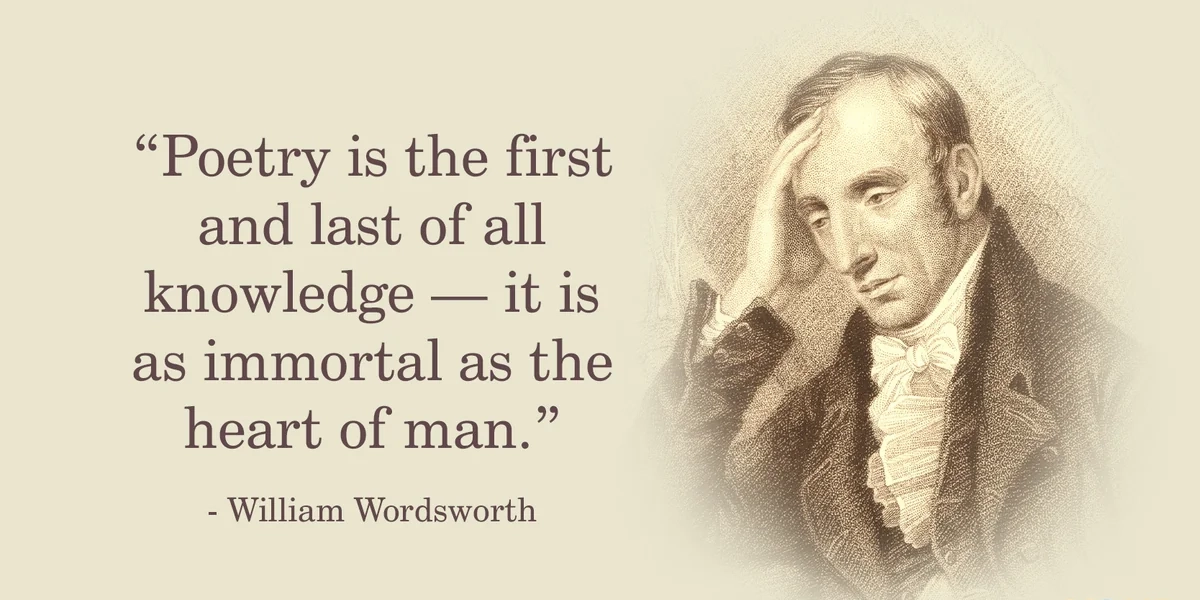
Wordsworth’s “Preface to Lyrical Ballads” (especially the 1800 and 1802 editions) is a foundational document for understanding his revolutionary stance on poetic diction. It’s in this preface that he most clearly articulates his critique of the prevailing poetic language of the 18th century and lays out his alternative vision.
Here’s a breakdown of Wordsworth’s key ideas on diction in the “Preface”:
1. Rejection of Poetic Diction:
- Critique of 18th-Century Language: Wordsworth vehemently condemned what he called the “gaudiness and inane phraseology” or “poetic diction” that dominated much of the poetry of his time. This artificial language, he argued, was characterized by:
- Periphrasis: Using lengthy or roundabout phrases instead of simple, direct words (e.g., “finny tribe” for fish, “feathered race” for birds).
- Personification of Abstracts: Giving human qualities to abstract concepts (e.g., “Pale Melancholy,” “Joy”). Wordsworth argued this was often a mechanical device to “elevate the style” rather than arising from genuine emotion.
- Archaic or Elevated Vocabulary: Employing words that were not in common usage or that sounded overly formal and “poetical.”
- Inverted Syntax: Rearranging word order unnaturally to fit meter or rhyme, leading to awkward and obscure phrasing.
- Overuse of Classical Allusions: Creating a barrier for readers unfamiliar with Greek and Roman mythology or history.
- Why He Rejected It: Wordsworth believed this artificial diction alienated the common reader, obscured true feeling, and prevented poetry from reflecting genuine human experience. He saw it as a “false refinement” that had corrupted the art.
2. Advocacy for “Language Really Used by Men”:
- Simplicity and Naturalness: Wordsworth’s core proposal was that poetry should employ “a selection of language really used by men.” He argued that this simpler, more natural language was inherently more expressive and powerful, especially when depicting fundamental human emotions.
- Focus on Rural and Humble Life: He specifically cited the language of “humble and rustic life” as particularly suitable. He reasoned that in this condition, “the essential passions of the heart find a better soil in which they can attain their maturity, are less under restraint, and speak a plainer and more emphatic language.” Moreover, he believed that the language of such individuals, being in constant communion with nature, was “a more permanent, and a far more philosophical language” than the “arbitrary and capricious habits of expression” often found in elevated circles.
- No Essential Difference Between Prose and Poetry (Except Meter): This was a particularly radical assertion. Wordsworth argued that “there neither is, nor can be, any essential difference between the language of prose and metrical composition.” He believed that the value of poetry lay in its subject matter and the power of its emotions, not in a distinct, artificial vocabulary. Meter, he conceded, was a difference, but he viewed it as an “additional charm” or a means of tempering strong emotion, not a justification for an entirely separate poetic lexicon.
- Purification from “Real Defects”: While advocating for common language, Wordsworth did not suggest a mere transcription of everyday speech. He acknowledged that the poet must purify this language from “what appear to be its real defects, from all lasting and rational causes of dislike or disgust.” This suggests a careful selection and refinement, removing vulgarity or triviality, to ensure that the language remains fitting for poetic expression.
3. The Role of Imagination in Diction:
- “Colouring of Imagination”: While championing simplicity, Wordsworth was clear that poetry was not simply prose arranged in lines. The poet’s imagination was crucial in “throw[ing] over them a certain colouring of imagination, whereby ordinary things should be presented to the mind in an unusual aspect.” This imaginative coloring elevated the seemingly mundane, revealing its hidden significance and beauty, even when expressed in common language. The power came not from artificial words, but from the poet’s insight.
Impact of Wordsworth’s Views on Diction:
Wordsworth’s arguments in the “Preface” were highly influential which are:
- Challenged Neoclassical Conventions: They directly attacked the aesthetic principles of the preceding era, paving the way for a more natural and accessible poetic style.
- Democratized Poetry: By advocating for the language of common life, he sought to broaden poetry’s appeal beyond a learned elite, making it relevant to a wider readership.
- Emphasized Authenticity: He shifted the focus from ornate expression to genuine emotion and sincere portrayal, believing that truth was best conveyed through unadorned language.
- Laid Groundwork for Future Romantics: His ideas deeply influenced subsequent Romantic poets, even if some, like Coleridge (who offered a friendly critique of Wordsworth’s extreme stance on the “no difference” argument in Biographia Literaria), debated the finer points of his theory.
In essence, Wordsworth’s “Preface” is a bold declaration of linguistic independence for poetry, arguing for a return to the natural rhythms and expressive power of everyday language as the true vehicle for poetic insight and feeling.
Aman Pal
Literatureman