
John Dryden’s An Essay of Dramatic Poesy is a landmark work of English literary criticism, published in 1668. Presented in the form of a dialogue, it is a sophisticated and engaging discussion of the nature and merits of drama, particularly the English stage. The essay, set during the naval battle between the English and Dutch fleets in 1665, features four fictional characters—Eugenius, Crites, Lisideius, and Neander—who represent different critical viewpoints. Through their spirited conversation, Dryden explores key debates of his time, including:
- The superiority of ancient vs. modern drama: Crites argues for the superiority of the classical Greek and Roman playwrights, emphasizing their adherence to the unities of time, place, and action. He critiques modern English drama for its disregard of these rules and its perceived lack of formal rigor.
- The use of rhyme in tragedy: A central point of contention is whether tragedy should be written in blank verse or rhyming couplets. Lisideius and Crites advocate for the latter, arguing that rhyme adds a certain nobility and polish suitable for heroic subjects. Neander, who is widely seen as representing Dryden’s own views, defends the use of blank verse, arguing that it is more natural and closer to spoken language, thus allowing for a greater range of expression.
- The merits of the French vs. the English stage: Lisideius champions the French stage, praising its adherence to the classical unities and its formal elegance. He suggests that the French playwrights’ strict adherence to rules results in more refined and polished works. Neander, however, defends the English stage, arguing that its greater variety of plot, character, and action makes it more entertaining and true to life. He also points out that the English stage’s use of a mix of comedy and tragedy (tragi-comedy) more accurately reflects the complexity of human experience.
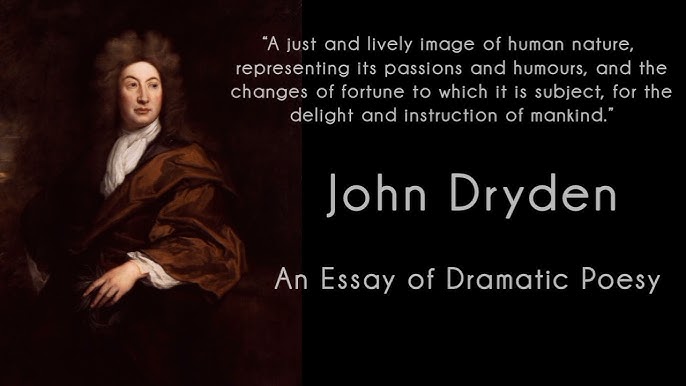
- The definition of a play: The characters offer various definitions of a play, with Neander’s being the most famous: “a just and lively image of human nature, representing its passions and humors, and the changes of fortune to which it is subject, for the delight and instruction of mankind.” This definition highlights the dual purpose of drama: to entertain and to teach.
Through this dramatic dialogue, Dryden presents a balanced and nuanced view of these issues. He avoids taking a dogmatic stance, instead allowing each character to make a compelling case for their perspective. Ultimately, the essay is a defense of English drama and its unique strengths. While he respects the classical and French models, Dryden argues that the English stage’s freedom from rigid rules allows for a greater richness, variety, and vitality. He champions the genius of playwrights like Shakespeare and Ben Jonson, whose works, while not always adhering to classical rules, possess a dramatic power and psychological depth that is uniquely English.
An Essay of Dramatic Poesy is significant for several reasons. It marks a turning point in English literary criticism, moving away from purely prescriptive rules towards a more analytical and comparative approach. Its use of the dialogue form makes the critical debate dynamic and accessible. Most importantly, it is a powerful articulation of the principles of Neoclassicism, yet it also foreshadows later Romantic ideas by championing the importance of individual genius and the naturalness of expression over rigid adherence to rules. It remains a foundational text for anyone studying English literary history and criticism.
Aman Pal
Literatureman