
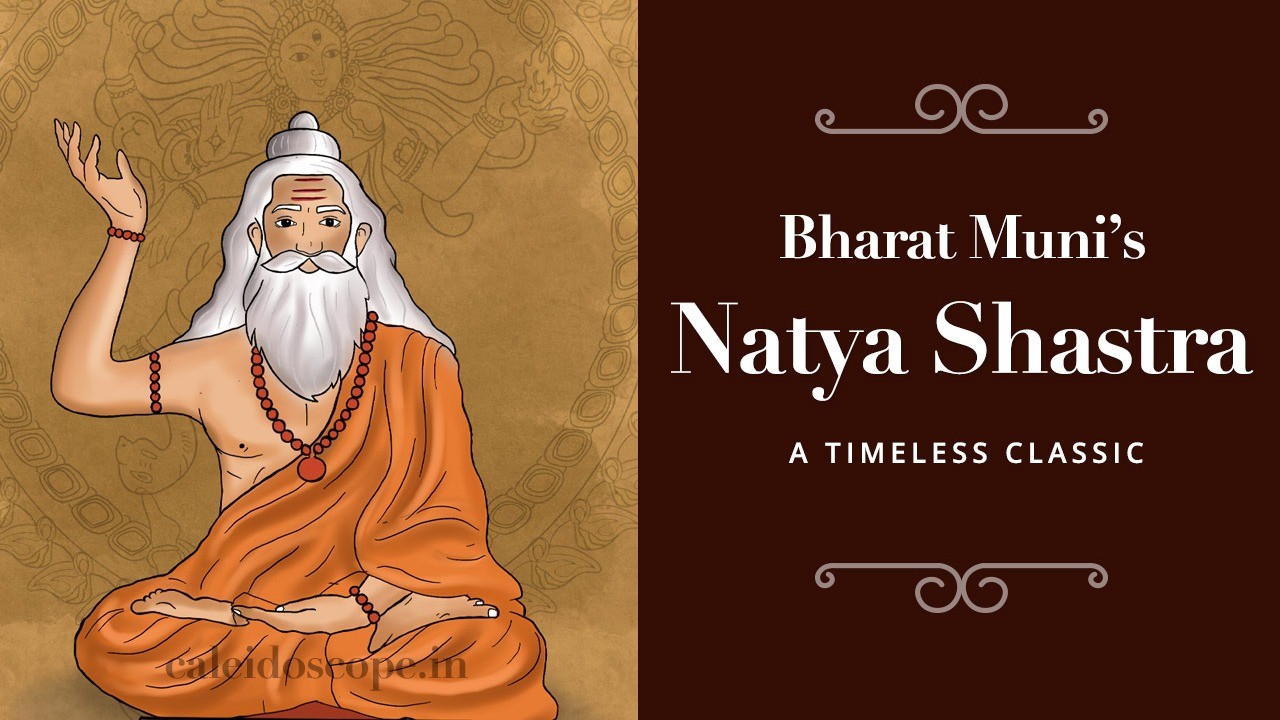
Before diving into Bharata Muni’s Natyashastra, one of the most significant and comprehensive treatises on Indian performing arts, here’s what you should know:
1. What is the Natyashastra?
- Ancient Encyclopedia: It’s an encyclopedic Sanskrit text, attributed to the sage Bharata Muni, covering virtually all aspects of ancient Indian drama, dance, and music. It’s often referred to as the “Science of Drama” or “Manual of Theatre.”
- Foundation of Indian Arts: It’s considered the foundational text for Indian classical performing arts, profoundly influencing forms like Bharatanatyam, Kathak, Kuchipudi, Odissi, and various forms of Indian theater and music.
- Scope: The text is remarkably comprehensive, detailing everything from stage construction, architecture, and costume design to acting techniques, vocalization, musical instruments, dance movements, and the profound theories of aesthetics.
- Structure: The most studied version comprises around 6000 poetic verses, primarily in Anustubh meter, spread over 36 chapters (though some versions have 37 or 38).
2. Key Concepts and Theories:
- Rasa and Bhava (The Core): This is arguably the most important contribution of the Natyashastra.
- Bhava (Emotional States): Bhavas are the emotional states or inner feelings that a performer expresses. These are primarily the Sthayi Bhavas (permanent moods, like love, anger, joy, sorrow, etc.) and Vyabhichari Bhavas (transient or complementary moods that support the main emotion). There are also Sattvik Bhavas (involuntary physical manifestations of emotions, like tears, trembling).
- Rasa (Aesthetic Experience): Rasa is the aesthetic experience or “flavor” that the audience savors when the bhava is effectively conveyed by the performer. Bharata Muni elucidated eight primary Rasas (later a ninth, Shanta, was added):
- Shringara (Love/Erotic)
- Hasya (Comic)
- Karuna (Pathos/Sorrow)
- Raudra (Fury/Anger)
- Vira (Heroism)
- Bhayanaka (Fear)
- Bibhatsa (Disgust)
- Adbhuta (Wonder)
- (Shanta – Tranquility, added later by Abhinavagupta)
- Rasa Sutra: The Natyashastra includes the famous Rasa Sutra, which explains the process of rasa manifestation.
- Abhinaya (Histrionic Representation): The fourfold division of acting:
- Angika Abhinaya: Body movements, gestures (mudras), postures, and facial expressions.
- Vachika Abhinaya: Speech, dialogue, intonation, and vocal delivery.
- Aharya Abhinaya: Costumes, makeup, jewelry, and stage properties.
- Sattvika Abhinaya: The true, genuine expression of internal emotions, arising from the actor’s inner being.
- Music and Dance: The text provides detailed instructions on various musical elements (swaras, ragas, talas), instruments, and dance movements (karanas and angaharas), including the 108 dance forms that influenced Indian temple sculptures (like the Nataraja at Chidambaram).
- Stagecraft: It discusses stage dimensions, types of stages, theatre architecture, seating arrangements, and lighting, emphasizing the stage as a sacred space.
- Types of Drama: It classifies different types of plays (e.g., Nataka, Prakarana).
- Concept of the “Model Spectator”: The idea that the audience also plays a crucial role in the theatrical experience, needing to be sensitive and receptive to fully appreciate the rasa.
3. Historical Context and Dating:
- Period: The exact dating of the Natyashastra is debated among scholars, ranging from 500 BCE to 500 CE, with many suggesting a compilation period between 200 BCE and 200 CE. It’s important to remember it’s not a single-author work composed at one time, but likely a collection of knowledge and practices that evolved over centuries.
- Oral Tradition: The knowledge contained in the Natyashastra was likely transmitted orally for generations before being compiled into a written text.
- Mythical Origin: The text itself begins with a mythical account of its origin, stating that it was created by Lord Brahma as a “fifth Veda” accessible to all, including those who couldn’t understand the existing Vedas, thus highlighting the inclusive and educational purpose of drama.
4. Why is it significant?
- Comprehensive Guide: It’s not merely a theoretical text but a practical guide for performers, playwrights, and directors.
- Holistic View of Art: It emphasizes the interconnectedness of all art forms (drama, music, dance) and their role in creating a complete aesthetic experience.
- Psychology of Aesthetics: It delves into the psychology of human emotions and how they can be effectively evoked and transmitted through performance to the audience.
- Cultural Influence: Its principles continue to form the bedrock of classical Indian performing arts, shaping their aesthetics, techniques, and philosophical underpinnings.
Before reading:
- Sanskrit Terminology: Be prepared for a lot of Sanskrit terms. Familiarizing yourself with key terms like “Rasa,” “Bhava,” and “Abhinaya” will be very helpful.
- Philosophical Depth: The Natyashastra is not just a technical manual; it delves into philosophical ideas about art, human nature, and the purpose of existence.
- Interpretations: Different scholars and traditions have interpreted the Natyashastra in various ways. Be open to these diverse perspectives.
- Not a Narrative: It’s not a story or a play. It’s a didactic treatise, meaning it aims to instruct and explain.
- Relevance Today: Despite its ancient origins, many of its principles remain highly relevant to understanding and practicing performing arts even today.
By keeping these points in mind, one will be be better equipped to appreciate the depth, breadth, and lasting impact of Bharata Muni’s Natyashastra.
Aman Pal
Literatureman