
John Osborne’s Look Back in Anger, which premiered at London’s Royal Court Theatre on May 8, 1956, is one of the most significant milestones in 20th-century British theater. It shattered the polite, upper-middle-class conventions of the “well-made play” and introduced a raw, unfiltered voice that captured a generation’s disillusionment.
Contents
- 1 1. Setting
- 2 2. Background and History
- 3 3. The “Angry Young Men” Movement
- 4 4. Kitchen Sink Drama
- 5 5. Major Character Sketches
- 6 6. Key Themes
- 7 7. Acts and Scenes Explanation
- 8 8. Social Issues Addressed in the Play
- 9 9. Literary and Dramatic Devices
- 10 10. Important Quotations and Explanations
- 10.1 1. “I suppose people of our generation aren’t able to die for good causes any longer. We had all that done for us before we were born. There aren’t any good, brave causes left.”
- 10.2 2. “She’s an old believer in the rule of law… She will pass by on the other side, and any folding of the hands to sleep is a sure sign of the Holy Spirit in action.”
- 10.3 3. “You’re hurt because everything is changed. Jimmy is hurt because everything is the same. And neither of you can face it.”
- 10.4 4. “I never knew what was going on out there… I challenge anyone to love her afterwards… She has no milk, only vinegar and sterling.”
- 10.5 5. “I want to be a lost cause. I want to be corrupt and Futile.”
1. Setting
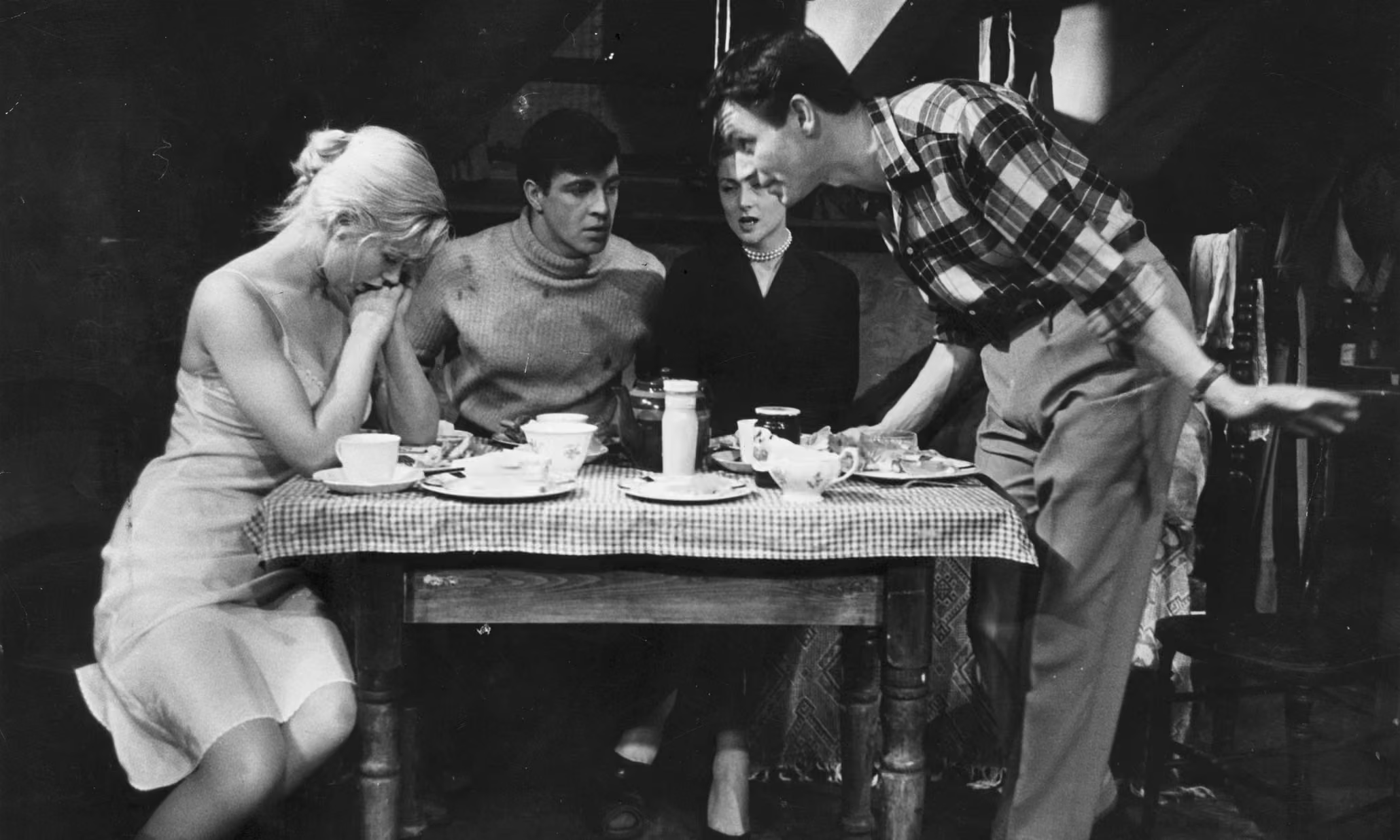
The entire play is confined to a one-room attic flat in a large Midland town in England.
- The Physical Space: The room is small, drab, and cramped, furnished with a double bed, a dressing table, a bookshelf, and a gas stove. A chest of drawers serves to support an ironing board where Alison spends much of her time.
- The Atmosphere: The environment is deliberately claustrophobic. It forces the characters into uncomfortable proximity, reflecting the stifling, inescapable nature of their socio-economic reality. The constant presence of mundane domesticity—newspapers, tea, ironing—contrasts sharply with the emotional violence of the dialogue.
2. Background and History
The mid-1950s in Britain was a period of profound transition and underlying anxiety, which serves as the backdrop for Osborne’s work.
- The Post-WWII Landscape: Although Britain had emerged victorious from World War II and established the Welfare State (including the NHS and expanded access to university education), class mobility remained largely stagnant. A new generation of working-class youths received an education but found themselves still shut out from positions of power, which were still guarded by the traditional elite.
- The Decline of Empire: The British Empire was rapidly dissolving. Characters like Colonel Redfern represent a nostalgic longing for the certainties of the Edwardian era, leaving the younger generation stranded in a gray, diminished post-imperial Britain with “no great noble causes left.”
3. The “Angry Young Men” Movement
The premiere of Look Back in Anger gave birth to the journalistic catchphrase “Angry Young Men.” This term described a loose collective of working- and middle-class British playwrights and novelists during the 1950s.
- Key Figures: Alongside John Osborne, writers like Kingsley Amis (Lucky Jim), Alan Sillitoe (Saturday Night and Sunday Morning), and John Braine (Room at the Top) shared this label.
- Core Philosophy: These writers were united by their bitter disillusionment with traditional British society, its rigid class hypocrisies, and the complacency of the welfare state. They rejected both the elite establishment and the polite, stylized literary forms of their predecessors (such as T.S. Eliot or Noël Coward), opting instead for a gritty, confrontational realism.
4. Kitchen Sink Drama
Osborne’s play pioneered Kitchen Sink Realism, a cultural movement that revitalized British theater, film, and television.
- Definition: The term refers to plays that focus on the domestic lives of working-class characters living in cramped rented spaces, spending their time performing mundane tasks like cooking, washing, and ironing.
- Thematic Impact: By moving the drama from aristocratic drawing rooms to a dingy attic flat, the “kitchen sink” approach democratized the stage. It asserted that the domestic anxieties, economic struggles, and raw psychological conflicts of the working class were worthy of serious tragic art.
5. Major Character Sketches
Jimmy Porter
The quintessential “Angry Young Man.” Educated at a “white-tile” (provincial, non-elite) university, he operates a sweet-stall to make a living. Jimmy is highly articulate, fiercely intelligent, and deeply cruel. He channels his frustration with the stagnant class system into relentless verbal assaults on his upper-middle-class wife, Alison, and society at large. He is a contradictory figure—simultaneously an empathetic defender of the marginalized and a tyrannical domestic abuser.
Alison Porter
Jimmy’s wife, who comes from a wealthy, privileged military family. She represents the very establishment Jimmy detests. Alison is passive, controlled, and uses a defense mechanism of “impenetrable quietness” to survive Jimmy’s emotional vitriol. Her posture behind the ironing board symbolizes her domestic captivity and her stoic endurance of her husband’s volatile temperament.
Cliff Lewis
A warm, working-class Welsh youth who lives with Jimmy and Alison. He acts as a crucial emotional buffer between the married couple. Cliff is gentle, uneducated, and intensely loyal. He provides Alison with the physical comfort and affection that Jimmy refuses to offer, maintaining the equilibrium of the household until he chooses to leave to find his own path.
Helena Charles
Alison’s sophisticated, upper-middle-class actress friend who comes to stay with the Porters. Initially, Helena acts as Alison’s protector, despising Jimmy and calling Colonel Redfern to rescue Alison from the flat. However, once Alison departs, Helena is drawn into an intense, passionate affair with Jimmy, stepping directly into Alison’s vacated domestic role behind the ironing board.
Colonel Redfern
Alison’s father, a retired British Army officer who spent his best years serving the Empire in India. He represents a bygone Edwardian era of elegance, order, and clear values. Unlike Jimmy’s caricature of the ruling class, the Colonel is a gentle, reflective man who recognizes that the world has left him behind, describing himself and Alison as “aliens” in the modern world.
6. Key Themes
Class Barriers and Social Stagnation
The central conflict stems from the unbridgeable gulf between Jimmy’s working-class background and Alison’s haute-bourgeoisie heritage. Jimmy resents that education did not grant him entry into the halls of power, leaving him to rot at a sweet-stall while the old-money establishment retains control.
The Loss of Ideals and “Great Causes”
Jimmy famously laments that there are no “good, brave causes left” to die for. Living in the shadow of World War II and witnessing the gray uniformity of post-war reconstruction, the characters suffer from a spiritual vacuum, finding nothing in modern society worth believing or fighting for.
Gender Dynamics and Emotional Sadism
The play explores the volatile, destructive nature of love. Jimmy equates true living with raw emotional vulnerability; because Alison refuses to break down, he subjects her to relentless psychological torment. The domestic chores—symbolized by the repetitive ironing—highlight the gendered traps of 1950s domesticity.
7. Acts and Scenes Explanation
[Act I: Sunday Morning] ──> [Act II, Scene 1: Weeks Later] ──> [Act II, Scene 2: Following Evening] │
[Act III, Scene 2: Months Later] <── [Act III, Scene 1: Months Later] <─┘
Act I
- The Setup: A dreary Sunday morning in the Porter flat. Jimmy and Cliff read the highbrow Sunday papers while Alison irons.
- The Action: Jimmy launches into extended, venomous monologues attacking the complacency of the press, the church, and specifically Alison’s family. He taunts Alison relentlessly. When Cliff and Jimmy playfully wrestle, they knock over the ironing board, burning Alison’s arm. Jimmy leaves, and Cliff tenderly comforts Alison, who reveals to Cliff that she is pregnant but too terrified to tell Jimmy.
Act II, Scene 1
- The Setup: Two weeks later. Alison is cooking tea; her actress friend Helena Charles is staying with them.
- The Action: Helena’s presence intensifies Jimmy’s rage. He delivers a brutal monologue recounting how he watched his idealist father die for months after returning from the Spanish Civil War, accusing Alison of being incapable of true feeling. Helena reveals she has telegraphed Alison’s father to fetch her. Jimmy receives a phone call that Hugh’s mother (the working-class woman who helped him set up his sweet-stall) is dying. He begs Alison to come with him to the hospital; she refuses, choosing to leave him instead.
Act II, Scene 2
- The Setup: The following evening. Colonel Redfern arrives to take Alison away.
- The Action: In a quiet, illuminating dialogue, the Colonel shows surprising empathy for Jimmy, admitting that he understands why a young man would fight against their class. Alison packs her things and leaves a note for Jimmy. After they depart, Helena stays behind to finish her theatre contract. Jimmy returns, devastated and furious after Hugh’s mother’s death. He discovers Alison’s note. When Helena confronts him, he lunges at her in anger, which abruptly transforms into a passionate embrace as the curtain falls.
Act III, Scene 1
- The Setup: Several months later. The scene deliberately mirrors Act I: a Sunday morning with Jimmy and Cliff reading papers, but Helena is now at the ironing board wearing Jimmy’s shirt.
- The Action: The dynamics are lighter, but the underlying rot remains. Jimmy, Cliff, and Helena engage in vaudeville routines. Cliff announces he is moving out to make something of himself. Suddenly, the door opens, and a pale, disheveled Alison enters the room.
Act III, Scene 2
- The Setup: Moments later. Helena and Alison talk privately.
- The Action: Alison reveals she lost the baby to a miscarriage. Overcome with guilt for violating her own moral code, Helena realizes her relationship with Jimmy is unsustainable and decides to leave.
- The Resolution: Left alone, Alison breaks down completely, falling to Jimmy’s feet and crying out that she is finally clean of her bourgeois detachment—she has experienced the raw, soul-crushing suffering Jimmy always demanded of her. Softened by her genuine despair, Jimmy comforts her. The play ends on a note of fragile, regressive retreat, as they escape their harsh reality by playing their childhood game of “bears and squirrels.”
8. Social Issues Addressed in the Play
Osborne used the Porter flat as a microscope to examine the systemic rot of mid-1950s British society.
The Illusion of Class Mobility
While post-WWII reforms (like the Education Act of 1944) allowed working-class youths to attend universities, the social hierarchy did not actually change. Jimmy has an elite education but cannot get an establishment job because he lacks the “right” family connections. He is left overqualified, underemployed, and running a sweet-stall—a stark critique of a stalled meritocracy.
Post-Colonial Nostalgia and Displacement
The play captures a Britain suffering an identity crisis after the collapse of its empire.
- The Older Generation (Colonel Redfern): Longs for the sunlit, orderly days of Edwardian England and imperial India.
- The Younger Generation (Jimmy): Is trapped in a gray, economically depressed, post-imperial reality.
- Neither generation knows how to live in the present; one looks back with nostalgia, the other with anger.
The Apathy of the Welfare State
Osborne targets the complacency of the post-war British public. With the introduction of the Welfare State, basic survival was guaranteed, but Jimmy argues that it stripped society of its passion. The “New Britain” is portrayed as dull, sterile, and terrified of raw emotion or radical change.
Gender and Domestic Captivity
The play highlights the rigid, suffocating gender roles of the 1950s. Alison is trapped in a cycle of domestic labor (symbolized by the endless ironing), while her emotional and reproductive choices are dictated entirely by the shifts in Jimmy’s temperament.
9. Literary and Dramatic Devices
Osborne broke away from the poetic, stylized dramas of his era by relying on gritty, realistic theatrical techniques.
- The Monologue as a Weapon: The play is structurally driven by Jimmy’s long, sprawling monologues. These aren’t traditional Shakespearean soliloquies meant to reveal inner thoughts to the audience; they are aggressive, rhetorical performances delivered at the other characters to provoke, wound, and dominate them.
- Objective Correlative (Visual Symbolism): Coined by T.S. Eliot, this device uses physical objects to signify emotional states.
- The Ironing Board: Represents the monotonous, crushing weight of domesticity and Alison’s submissive, silent endurance.
- The Pipe and Jazz Trumpet: Jimmy’s pipe fills the room with smoke, physically suffocating Alison and Helena. His off-stage jazz trumpet is loud, discordant, and intrusive—a sonic extension of his rebellion and ego.
- Animal Imagery (The Bears and Squirrels Game): Jimmy and Alison escape their brutal class warfare through a regressive childhood game. Jimmy is the large, messy Bear; Alison is the timid, neat Squirrel. It is a vital literary device showing that their love can only survive if they strip away their human identities and societal baggage.
- Naturalistic Dialogue: Osborne discarded high-society wit and drawing-room banter for raw, colloquial, and sometimes crude everyday speech, mimicking the actual rhythms of mid-century working-class life.
10. Important Quotations and Explanations
1. “I suppose people of our generation aren’t able to die for good causes any longer. We had all that done for us before we were born. There aren’t any good, brave causes left.”
— Jimmy Porter (Act III, Scene 1)
- Context: Jimmy is talking to Cliff and Helena on a Sunday morning, lamenting the lack of purpose in modern life.
- Explanation: This is the defining quote of the Angry Young Men movement. Jimmy feels cheated by history. The older generation fought World War II and built the Welfare State, leaving his generation with comfort but no grand ideological battles to fight. It explains the root of his anger: it is not just economic frustration, but a deep, existential boredom.
2. “She’s an old believer in the rule of law… She will pass by on the other side, and any folding of the hands to sleep is a sure sign of the Holy Spirit in action.”
— Jimmy Porter (Act I)
- Context: Jimmy is viciously mocking Alison’s mother and her upper-class family’s religious and social hypocrisy.
- Explanation: Jimmy uses biblical allusions (referencing the parable of the Good Samaritan who “passed by on the other side”) to attack the bourgeoisie. He argues that the upper class uses morality, manners, and religion not to help people, but as a shield to ignore the suffering of the lower classes while keeping their own hands clean.
3. “You’re hurt because everything is changed. Jimmy is hurt because everything is the same. And neither of you can face it.”
— Alison Porter (Act II, Scene 2)
- Context: Alison is speaking to her father, Colonel Redfern, right before she leaves the flat to return home.
- Explanation: This is a brilliant piece of character and social insight. Alison perfectly diagnoses the generational divide of 1950s Britain. The Colonel is heartbroken because the old, elegant British Empire he loved has vanished. Jimmy is furious because, despite the war and the political rhetoric, the oppressive class system remains completely unchanged. Both men are paralyzed by their inability to accept the present.
4. “I never knew what was going on out there… I challenge anyone to love her afterwards… She has no milk, only vinegar and sterling.”
— Jimmy Porter (Act II, Scene 1)
- Context: Jimmy is describing to Helena how he watched his idealist father die a slow, lonely death after returning from the Spanish Civil War, while his mother looked on with cold indifference.
- Explanation: This quote exposes Jimmy’s core psychological trauma. He equates the upper-middle class (represented by his mother and Alison) with emotional deadness. To Jimmy, they lack human empathy (“no milk”) and care only about social status and money (“sterling”). This trauma is why he relentlessly attacks Alison; he is terrified she will treat him with the same cold detachment his mother showed his dying father.
5. “I want to be a lost cause. I want to be corrupt and Futile.”
— Alison Porter (Act III, Scene 2)
- Context: The climax of the play. Alison has returned after losing her unborn baby and collapses on the floor in front of Jimmy.
- Explanation: Throughout the play, Jimmy abuses Alison because she has never known real, gut-wrenching suffering. Here, broken by the miscarriage and the loss of her marriage, Alison finally breaks through her “impenetrable quietness.” She surrenders her upper-class dignity and accepts the raw, messy emotional reality Jimmy always demanded. It is a tragic moment: she can only reunite with her husband by completely destroying her self-esteem.
Aman Pal
Literatureman