
1. Introduction
“The Bus” by Arun Kolatkar, the legendary opening poem of his 1976 Commonwealth Poetry Prize-winning collection, Jejuri, a 31-poem sequence detailing a modern, secular protagonist’s (often identified as Manohar) day-trip to the temple town of Jejuri in Maharashtra.
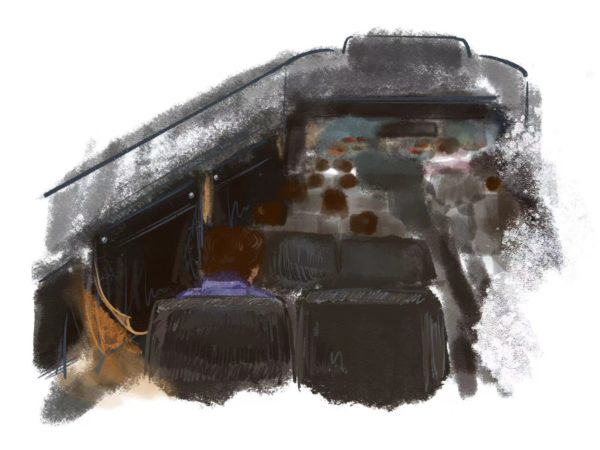
Instead of opening a religious pilgrimage with spiritual ecstasy or holy invocation, Kolatkar grounds the collection in the gritty, uncomfortable reality of a commercial State Transport bus during an early morning ride. The poem establishes a profound thematic tension: the clash between modern skepticism (represented by the narrator) and traditional faith (represented by an old, devout passenger). Written in spare, avant-garde free verse, the poem strips away the romanticism of religious journeys, presenting instead a world of sensory discomfort and fragmented identity.
2. Line-by-Line Analysis
“the tarpaulin flaps are buttoned down / on the windows of the state transport bus. / all the way up to jejuri.”
- Analysis: The poem immediately establishes a claustrophobic, closed-off environment. In 1970s India, local state transport buses used heavy waterproof canvas sheets (tarpaulin) instead of glass windows to keep out rain and wind. By starting with “buttoned down” flaps, Kolatkar visually and metaphorically blocks out the external world. The passengers are insulated, traveling blindly toward their destination, Jejuri.
“a cold wind keeps whipping / and slapping a corner of tarpaulin / at your elbow.”
- Analysis: The narrative voice shifts to the second person (“your”), pulling the reader directly into the physical discomfort of the journey. The words “whipping” and “slapping” are aggressive and violent, emphasizing the harshness of the weather and the cheap, rattling nature of public transit.
“you look down to the roaring road. / you search for the signs of daybreak / in what little light spills out of bus.”
- Analysis: Unable to see clearly through the buttoned-down sheets, the passenger looks down at the ground through the gaps. The “roaring road” highlights the loud, mechanical engine noise. The passenger looks for “daybreak”—a universal symbol of enlightenment, clarity, or a new beginning—but finding it is a struggle. There is only a dim, artificial glow spilling out from the internal bus lights.
“your own divided face in the pair of glasses / on an oldman`s nose. / is all the countryside you get to see.”
- Analysis: This is the visual climax of the first half of the poem. Because the window flaps are down, the narrator cannot see the passing landscape (“the countryside”). Instead, when he looks across the aisle, he sees his own reflection warped and split into two distinct lenses on an old man’s spectacles. This “divided face” represents a fragmented sense of self—the inner conflict of a modern intellectual embarking on a religious pilgrimage he doesn’t truly believe in.
“you seem to move continually forward. / toward a destination / just beyond the castemark beyond his eyebrows.”
- Analysis: The movement feels passive (“you seem to move”). The old man wears a “castemark” (a religious symbol painted on the forehead, common among orthodox Hindus). Metaphorically, the bus is traveling toward a physical place (Jejuri), but the narrator’s psychological journey is trying to penetrate or understand what lies beyond the old man’s faith.
“outside, the sun has risen quitely / it aims through an eyelet in the tarpaulin. / and shoots at the oldman`s glasses.”
- Analysis: Daybreak finally arrives, but it is described using violent, ballistic imagery. The sun “aims” and “shoots” like a sniper through a tiny metal ring (“eyelet”) in the canvas flap. The targets of this sudden light are the old man’s glasses, momentarily blinding the reflection and breaking the spell of the traveler’s introspection.
“a sawed off sunbeam comes to rest / gently against the driver`s right temple.”
- Analysis: The ballistic metaphor continues with a “sawed off sunbeam” (evoking a sawed-off shotgun). Yet, ironically, it rests “gently” against the driver. The beam of light functions as a sudden moment of physical orientation and navigation.
“the bus seems to change direction. / at the end of bumpy ride / with your own face on the either side / when you get off the bus.”
- Analysis: Bathed in the new light of morning, the vehicle shifts its course as it nears the town. The physical trial (“bumpy ride”) is coming to a close, and the narrator is left with the lingering image of his split reflection.
“you dont step inside the old man`s head.”
- Analysis: The final, single-line stanza serves as a sharp, unsentimental conclusion. Despite sitting opposite each other, sharing the same physical hardships, and seeing his own face reflected on the old man’s eyes, the narrator realizes a fundamental truth: he cannot bridge the gap between them. He remains an alienated, objective observer. He leaves the bus without adopting, understanding, or “stepping inside” the traditional, faith-driven mindset of the old devotee.
3. Figures of Speech
Kolatkar relies heavily on stark imagery and unexpected literary devices to create meaning:
- Personification: The cold wind is given human attributes of anger and malice as it keeps “whipping and slapping” the tarpaulin against the passenger’s elbow.
- Metaphor:
- The “divided face” is a profound metaphor for modern identity crisis, internal alienation, and the split between intellect and tradition.
- The “caste mark” represents the ancient, unyielding structure of religious orthodoxy.
- Extended Military / Ballistic Imagery: The sun and its light are described using weaponized terminology (“aims”, “shoots”, “sawed off sunbeam”). This implies that light (or truth/reality) doesn’t gently dawn on the passengers; it aggressively pierces through their artificial insulation.
- Synecdoche: The narrator reduces the old man entirely to his features—his nose, his spectacles, his eyebrows, and his caste mark—treating him almost like a landscape or a monument to be observed rather than a whole human being.
4. Conclusion
“The Bus” is a masterclass in modernist Indian poetry. By using a highly clinical, detached, and objective tone, Kolatkar subverts the traditional expectations of a “spiritual journey.” The poem concludes not with a grand epiphany or communal bonding, but with a stark reminder of human isolation. The physical journey to Jejuri has ended, but the psychological gap between the skeptical modern individual and the deeply rooted world of traditional faith remains completely unbreached.
Aman Pal
Literatureman